Journal | Issue 21
Organizational Learning
Evolving Requires Avoiding the Traps of Ignoring, Hoarding, and Stagnating
As a longtime transparency champion, and a professional librarian, PEAK’s Learn, Share, Evolve Principle resonates deeply with me. Since my journey into philanthropy was made through the pathway of libraries and knowledge management, I was delighted to discover the joys of PEAK, where grants professionals help their institutions make sense of the copious amounts of data they generate. Later, as a PEAK board member during the period when we were introducing the Principles for Peak Grantmaking, I was inspired by the move to help members act on these new Principles and find ways to measure philanthropy’s collective progress in these efforts.
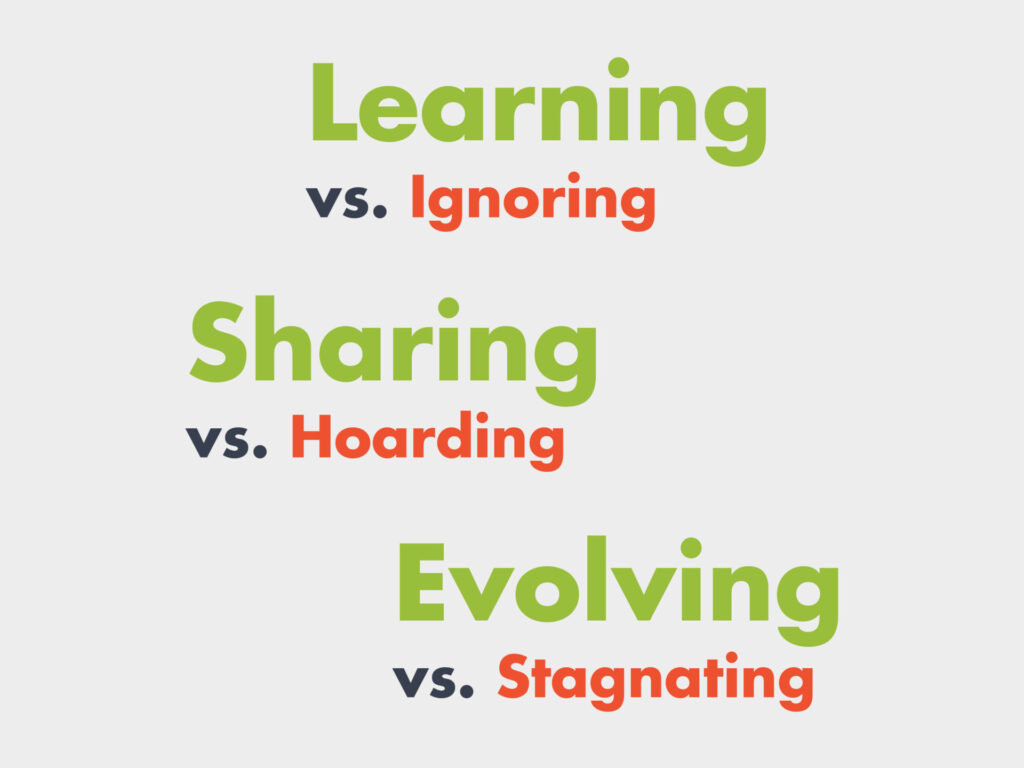
But the Principles can be elusive to manifest, operationalize, and tangibly define. One illuminating approach to intangibles like values and principles is to consider opposite behaviors as a way to understand what may be needed. So, in this case, the opposites of learning, sharing, and evolving are ignoring, hoarding, and stagnating. Sadly, to those of us who have worked in the field of philanthropy for a long time, that latter trio of descriptors might sound all too familiar. Let’s look a little more closely at this study in contrasts to help change entrenched behaviors that may be holding back your grantmaking.
Learning vs. ignoring
Creating a culture of learning inside your organization has both internal and external dimensions. Starting from the inside out, you can begin by thinking about your knowledge management practices and how easy (or difficult) it is for your staff to learn from their colleagues and their body of work. Then, branch out beyond the four walls of your institution to create a culture of learning by listening, engaging with peer networks, and connecting with the communities you support.
Learning behaviors
- The funder has organized and centralized its knowledge so all staff know how to access, benefit from, and build on it.
- The funder invests in professional development and encourages staff to participate in philanthropy-supporting organizations, regional grantmaking groups, and community engagement in order to share knowledge and learn from peers and stakeholders.
- The funder invites, listens, and acts on external stakeholder feedback.
Ignoring behaviors
- The funder’s knowledge is fragmented, staff-dependent, and usually inaccessible following staff turnover in key roles.
- Staff are discouraged from taking time and resources to join professional associations or participate in courses and conferences.
- The funder is inaccessible to the outside world, with very little information provided about how decisions are made, who makes the decisions, and how to engage with them.
 Ways to make the shift
- Select a grants management system (GMS) that staff across the organization will find accessible and user-friendly to mine for data. And while you’re at it, advance on the sharing part of this Principle by verifying that the GMS is designed for interoperability so that your data can be shared with other systems across the field.
- Build professional development goals into your staff performance review process to make this a priority. Such goals can include knowledge sharing with staff so new knowledge is imported organization wide. Performance goals for public speaking that include audiences reached can serve to advance your organization’s outreach goals. In addition to PEAK, there are funder affinity groups and philanthropy support organizations for numerous fields and causes.
- Stakeholder engagement is a key element of organizational learning, so it’s important for funders to create ways to collect input and knowledge from grantees and applicants. The Center for Effective Philanthropy (CEP) has a long track record of helping funders learn from grantees through its well-established Grantee Perception Report service. A majority of those who have collected this feedback via CEP have made changes as a result, underscoring the importance of what you can learn by listening to your grantees and applicants.
- In addition to directly surveying your grantees and applicants, go where they are talking about you and see what they have to say. GrantAdvisor provides an anonymous platform where nonprofit organizations can review (and sometimes vent about) funders’ processes. Savvy funders go there to listen in, identify opportunities for improvement, and respond.
Sharing vs. hoarding
As a sector devoted to using its considerable resources to advance the public good, it is disappointing how often the value of its knowledge goes untapped. Everything from lessons learned via programmatic efforts to demographic data about our workforce is held close to the vest rather than offered transparently in a spirit of partnership with the communities we support. This reluctance to openly share the knowledge and data that funders have access to undermines the field’s ability to deliver on its mandate to advance the public good.
Given the paper-pushing history at legacy foundations, the tendency to hoard knowledge is not a surprise. After all, in the days of file cabinets and hard copies, it was not easy to identify, extract, and share knowledge with the outside world. But in today’s world of digital information, social platforms, and grants and knowledge management systems, it should be much easier for institutions to access, import, and export knowledge. If philanthropic organizations understand that knowledge is a form of power, making the choice not to share it is a path that empowers the funding institution but not its partners.
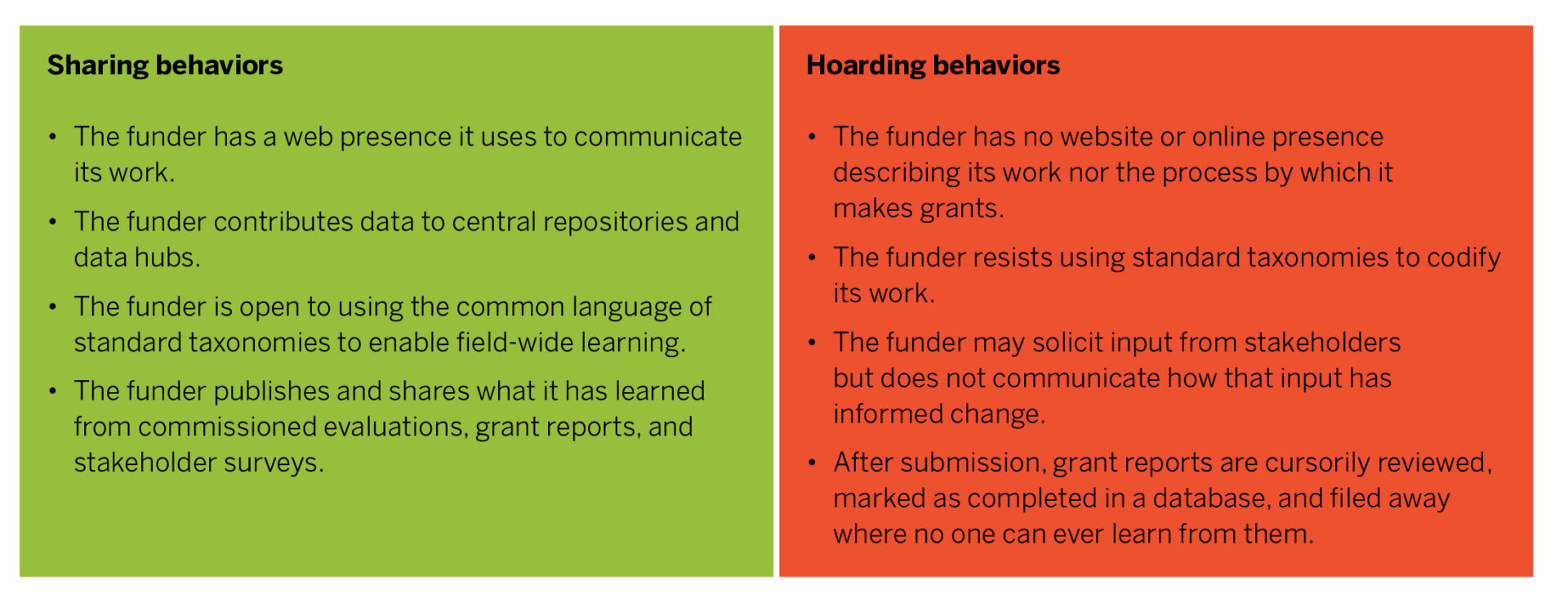
Sharing behaviors
- The funder has a web presence it uses to communicate its work.
- The funder contributes data to central repositories and data hubs.
- The funder is open to using the common language of standard taxonomies to enable field-wide learning.
- The funder publishes and shares what it has learned from commissioned evaluations, grant reports, and stakeholder surveys.
Hoarding behaviors
- The funder has no website or online presence describing its work nor the process by which it makes grants.
- The funder resists using standard taxonomies to codify its work.
- The funder may solicit input from stakeholders but does not communicate how that input has informed change.
- After submission, grant reports are cursorily reviewed, marked as completed in a database, and filed away where no one can ever learn from them.
 Ways to make the shift
- Establish a web presence to share your latest grants data in machine-readable formats and create an easy onramp for stakeholders to understand how your organization works. According to Candid, only 10 percent of foundations have a website, so technology and transparency are still a weakness for most institutional philanthropy. Smaller and new funders who struggle with developing a website may want to consider using their Candid profile as an easy way to develop a web presence. There, they can share contact information, leadership information, program priorities, and grant application processes.
- Help advance the social sector as a whole by joining the movement for more effective, equitable, and efficient demographic data collection and sharing with Demographics via Candid. If you’re asking for demographic data, encourage your grantees to share it via their Candid profile, where multiple funders can freely access it. This unburdens nonprofits from repeated requests, while creating a collective industry standard.
- Adopt an approach to intellectual property that enables knowledge to be shared and used, either through an open licensing policy or blanket permission statement that allows others to distribute, adapt, and build on your material.
- Ask grantees and evaluation partners to deposit knowledge products in repositories such as Issue Lab and Open Educational Resources where they can be easily accessed by anyone.
- Leverage stakeholder surveys and listening tours as opportunities to build trust with your community by informing them what you learned from their input and what you will change as a result.
- Use Candid’s Philanthropy Classification System (PCS) as the basis for your grants coding. The PCS describes the work of grantmakers, recipient organizations, and the philanthropic transactions between those entities. The PCS is based on the National Taxonomy of Exempt Entities and has been expanded over the last three decades based on external stakeholder input.
Evolving vs. stagnating
When thinking about change and evolution, it’s important to consider both institutional and field-wide evolution. At the institutional level, do you have a shared understanding of your organization’s goals and how you are measuring progress toward those goals? Did a diverse range of stakeholders have the opportunity to provide input into your plan, especially those with lived experience in the communities you serve? Of course, that’s no small task to complete, but once you have such a plan in place, don’t fall in love with your framework so much that you forget to think about leveraging the influence you have as a funder to take collective action that can move the field forward. For example, it’s difficult to make and measure progress in a field of nonexistent or fragmented knowledge that resists taxonomies and standards in favor of singular approaches and frameworks.
Also note that when making shifts, institutions may face cultural barriers in addition to capacity barriers, and it can be unclear how to pave the way for evolution. The resources below can help you overcome these barriers.
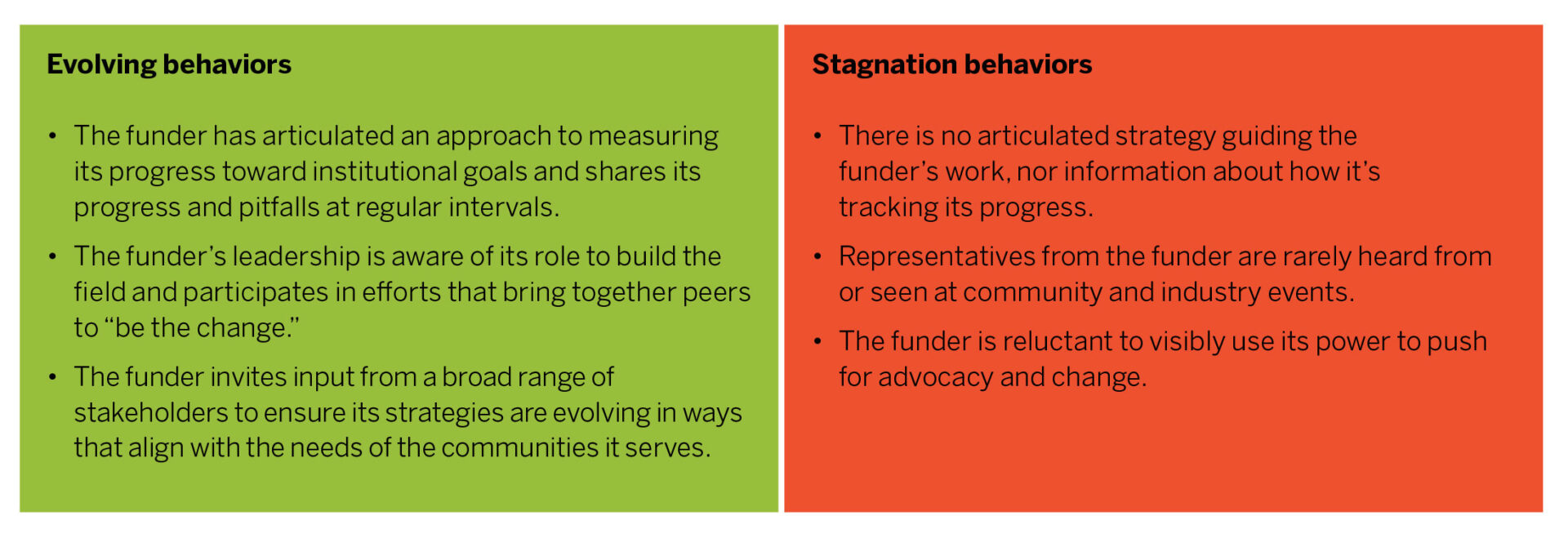
Evolving behaviors
- The funder has articulated an approach to measuring its progress toward institutional goals and shares its progress and pitfalls at regular intervals.
- The funder’s leadership is aware of its role to build the field and participates in efforts that bring together peers to “be the change.”
- The funder invites input from a broad range of stakeholders to ensure its strategies are evolving in ways that align with the needs of the communities it serves.
Stagnation behaviors
- There is no articulated strategy guiding the funder’s work, nor information about how it’s tracking its progress.
- Representatives from the funder are rarely heard from or seen at community and industry events.
- The funder is reluctant to visibly use its power to push for advocacy and change.
 Ways to make the shift
- Join professional networks and social sector standard bearers, like PEAK, to bring in best practices for motivating change.
- Use PEAK’s Principles toolkits to elevate your work. Start by exploring how to align your practices with values—the best place to begin any culture change effort.
- Commit to ongoing improvement and transformation and use the power of your organization’s position and platform to grow the movement.
The metaphor of sparking a flame is often used when referring to change. Fire needs fuel, oxygen, and heat to create that spark. And for change, you need learning, sharing, and evolving to spark the transformation. So, as you review the above study in contrasts and prescriptions for change, it’s likely that you become aware of some areas of strength as well as weakness. For example, what if you’re good at learning, but not sharing? Some funders may have added roles dedicated to evaluation and learning, but if there are silos that prevent that team from working with the communications team to package and share the findings, there are missed opportunities to leverage that learning for change. Similarly, you may realize you started with a values statement that includes a commitment to learning and transparency, but not really know where to begin to make it manifest. These are not overnight transformations focused on an endpoint, but a commitment to ongoing improvement and transformation. Adopting this kind of principled approach to grantmaking provides an opportunity for deep learning, engagement, and sparking that evolution toward the world we are trying to create.
Meet the Author

Janet Camarena
Director of Partnerships, Candid
Principles for Peak Grantmaking
Read more insights related to this Principle:
Learn, Share, Evolve
Related Topics
Organizational LearningRelated Articles
Maintaining the Learning Momentum After a PEAK Convening
READ
How a PEAK–BSU Partnership Helped Me See a Career in Philanthropy
READ
Six Insights on Organizational Learning
READ