You may be stewarding your nonprofit partnerships responsibly, but are you stewarding them responsively?
First, grantmakers must redirect their understanding of the term stewardship. Rather than taking on the role of supervisor—the classic position funders have most often taken—grantmakers can break down the inherent power imbalance by emphasizing their role as a partner. Taking a page from nonprofits, funders must instead treat stewardship as the process of nurturing relationships—not managing an expenditure.
The second part is embracing the value of being responsive, rather than merely responsible—a two-way exchange as opposed to a one-sided arrangement. A responsive funder is flexible, equitable, and aware, centering the needs of nonprofit partners and their communities to make a lasting impact.
The hallmarks of a responsive steward? Communication, transparency, and adaptive practices. The goals of responsive stewardship? Lighter burdens, greater trust, and a higher degree of equity and efficiency for everyone involved—especially for nonprofits and the people they serve.
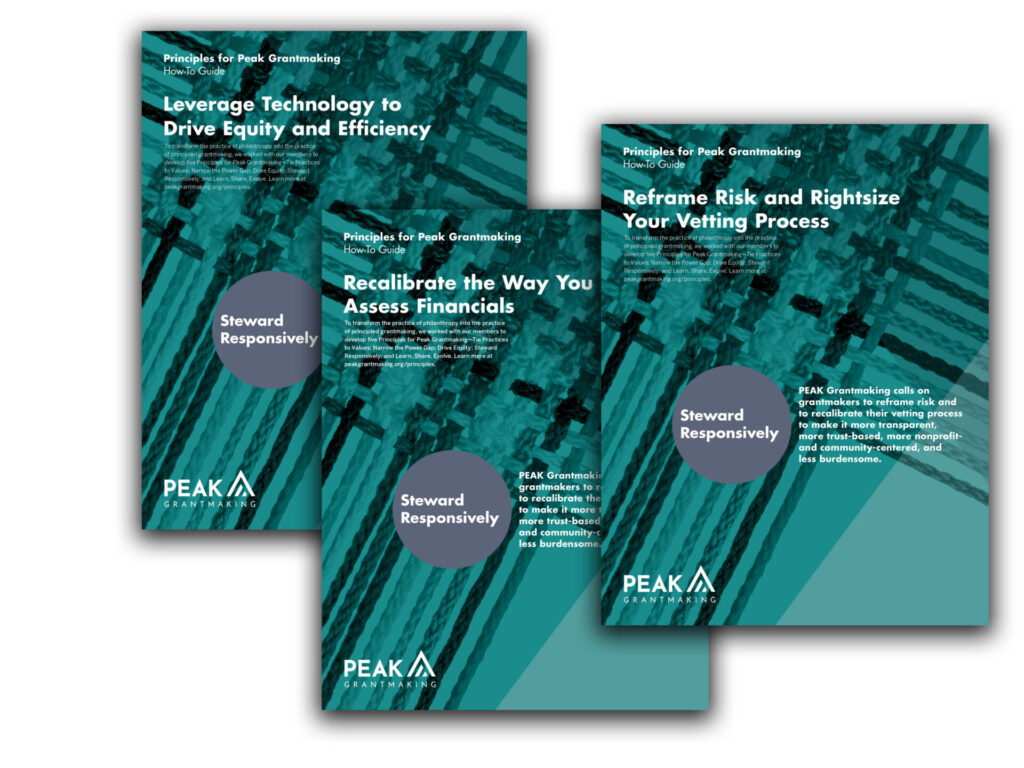
PEAK’s Steward Responsively Collection features three how-to guides each exclusive to Organization Members—that walk you through the process behind each of these critical actions you need to take to put this Principle into practice:
- Reframe Risk and Rightsize Your Vetting Protocols
- Recalibrate the Way You Assess Financials
- Leverage Technology to Drive Equity and Efficiency
Here, get a feel for the work that goes into responsive stewardship with a lesson from each of the guides.
Centering equity in the vetting process
The vetting process should not only assess risk to the funder, but also consider the risk from the applicant’s perspective, including adverse impacts from the potential partnership to their operations and reputation in the community. Funders should reflect on the power dynamics present and identify opportunities to adapt and shift. The goal should be to ensure the relationship is mutually beneficial to the funder and the nonprofit.
So how do you evaluate risk to a grantee? Consider a few of the ways grantmaking risks play out on the nonprofit’s side:
- Needs alignment: Will this grant prioritize the most urgent community needs, or will it uplift other needs that, while important, take the focus off more pressing matters?
- Outcome projection: Will this investment support the outcomes this community needs? How do we know this is what the community needs?
- Reputational risk: How will the partnership and investment be perceived? Will our investment promote trust, impact, and security in the community? Might this partnership negatively affect the nonprofit’s reputation in the eyes of the community served?
- Financial priorities: What kind and level of support is needed to achieve the shared outcomes we seek? Are the terms significant and flexible enough to meet the varying needs of the communities involved and any changing community dynamics?
Assessing nonprofit financials
When a funder works closely with current and potential grantees to fully consider both the needs of the nonprofit as well as the work to be funded, the dividends are exponential.
Here are a few questions you may consider asking nonprofit staff and board members, depending on the nature and size of the grant:
- How can we, as a funder, best support you?
- What limitations or capacity challenges do you have?
- What are the organization’s capacity goals, short-and long-term?
- Who completes the financials?
- How often does the board review your financials?
- Do you have a preference for when the grant is awarded and paid? (Consider asking this if your target award and/or payment date is close to an organization’s fiscal end-of-year.)
To understand a nonprofit’s financial health, funders should especially focus on learning about the organization’s financial planning and budgeting practices. Knowing if the organization is allocating revenue to cover the true cost of doing business (direct and indirect costs), and planning for the future (budgeting and reserve policies) can be critical to making well-informed assessments of an organization’s financial health and future outlook. All of this can inform the kind of support provided to the organization: an operating or program support grant, capacity building support, or an opportunity to provide additional guidance on more comprehensive ways to develop grant budgets. All of this depends on the size and capacity of the nonprofit and the funder.
For example, say part of a grant request involves collecting information from a specific demographic group in a specific area. Does collecting this information require the nonprofit’s staff to travel to this area? If so, budgeted costs should include not just travel, but food for both the nonprofit’s staff and the potential participants. Will the participants be compensated? If so, their compensation should also be budgeted. If participants need to engage via the internet, is there funding for cloud software?
Centering equity through technology
There are some significant opportunities for utilizing technology applications as a primary tool for equitable, effective, responsive grantmaking practices. Here are a few to consider.
- Adaptability is critical. As flexible as technology can be, software and applications aren’t always designed with ease-of-use and adaptability in mind. For example, a sophisticated cloud-based grant application may not be accessible to neighborhood groups or grassroots organizations with limited computer or internet access. Other organizations may not trust that banking information shared through an online platform is safe from hackers or be comfortable using or learning new technology.
- Consider all parties. For each of the tools you select, be sure to identify all users—inside and outside of the organization. Technology must be accessible to individuals with varying backgrounds and abilities–consider language preferences or potential disabilities that could influence how organizations can fully access these tools. Ample time and training should be provided so that users in different roles are able to complete their work, and for external users like your board, community reviewers, and nonprofit partners have clear and easy access as needed.
- Only ask for what you’ll use. Funders often sit on data that is not used for decision-making or knowledge sharing. Innovative technology tools can encourage this as well. Be strategic as you plan around the tools you will adopt, and which information each tool should hold, considering how your data needs might change as well as what information is required (as opposed to interesting to gather). After implementation, check in regularly to ensure that the data collected is really the data that’s needed.
“I implore you to advocate that the castles of philanthropy do not warrant the moats devised to protect its assets,” PEAK President and CEO Satonya Fair wrote earlier this year. “In putting aside notions of risk, nobody is asking funders to climb the castle tower and throw all your loot into the wind and hope the treasure floats toward need. Walk to the village center. Get to know the townspeople. Find out who needs what, which solutions are working, and who’s already doing the good work or poised to take up that quest. Align your goals with their skills, make the investment, and remember that doing transformational things takes time.”
To explore these themes in greater depth, click here to explore the Steward Responsively Collection. The three how-to guides are exclusively available to Organization Members, while the action planner, Strategies to Steward Responsively, is open to all.
Meet the Author

Vanessa Elkan
Senior Knowledge and Learning Manager, PEAK Grantmaking

Lita Pardi
Knowledge and Learning Director, PEAK Grantmaking
Principles for Peak Grantmaking
Read more insights related to this Principle:
Steward Responsively
Related Topics
Grantmaking LifecycleRisk, Finances & Compliance
Related Articles
Beyond Annual Renewals: How Multiyear GOS Changes Grants Management
READ
Rethinking Indirect Cost Rates to Support Nonprofit Financial Health
READ
The Ultimate Guide to Automation in Grants Management
READ