Two grantmaking advisors from BDO headlined the PEAK2023 hybrid session “Nonprofit Financial Health in Today’s Context,” covering the topline data to consider for assessing the financial situation of a potential grantee. On-hand were Hilda Polanco, market managing partner with BDO’s Nonprofit and Grantmaker Advisory Services, and BDO Director of Philanthropic Services Jennifer Pedroni.
Among the topics covered were the financial trends putting pressure on nonprofits right now, and the three financial data points that Polanco described as “absolutely top of mind for us.” Below are highlights from their discussion. Quotes have been lightly edited for length and clarity.
Meeting the moment
Polanco began the conversation by addressing sector trends putting pressure on nonprofits’ financial health, including the end of pandemic-related relief funds, increases in staff turnover, and high rates of inflation. Polanco spoke to the latter point: “For a $50,000 grant in the year 2000 to have the same purchasing power in 2020, that grant would need to be almost $25,000 higher. Only two years later, that $50,000 grant would need an additional $35,000.”
One area that inflation hits nonprofits particularly hard, Polanco noted, is compensation. “In the last two years, every indicator shows that in order to keep up with inflation, we’re looking at 5 percent increases in compensation.” Because compensation accounts for roughly 80 percent of most nonprofits’ budgets, that 5 percent means a significant challenge for organizations.
“So how do we factor that into grantmaking?” Polanco continued.” Go back to your teams and explore how you are thinking about multi-year fixed dollar amounts. For example, in a three-year grant, ask: Do we expect $100,000 to go as far in years two and three as it did in year one?”
The effect of inflation can be compounded by grantmaker inflexibility, especially regarding smaller organizations. “We’ve worked with many foundations that say they believe in equity. Then they have a requirement not to fund more than 30 percent of an organization’s budget,” said Polanco. If every funder uses this one-size-fits-all spending cap, she notes, small organizations will be unable to grow. “That’s a self-perpetuating limitation.”
Polanco urged funders to consider the indirect costs nonprofits take on when pursuing and accepting grants. In a study BDO conducted with the Annie E. Casey Foundation, they found that “the smaller the budget, the higher the indirect cost rate.” A smaller organization may not even have the capacity to calculate true cost due to already-stretched resources: “Funders may need to provide a bit of extra help to determine that.”
Pedroni added project-only funders to that discussion as well: “How can you make sure that your project grants are covering the indirect costs required to support the project? How do you meet people where they are and help them think about and address that?”
Three critical financial health factors
Though there are many factors to consider when assessing the financial situation of an organization, Polanco and Pedroni singled out three indicators they would look to before any others:
- Operating reserves, also known as liquid unrestricted net assets (LUNA);
- Liquidity, or how many months of cash an organization has on hand; and
- Operating results, specifically in terms of surpluses and deficits.
Polanco clarified that these factors are to be considered across a number of years: “We’re speaking about trends, not a moment in time.”
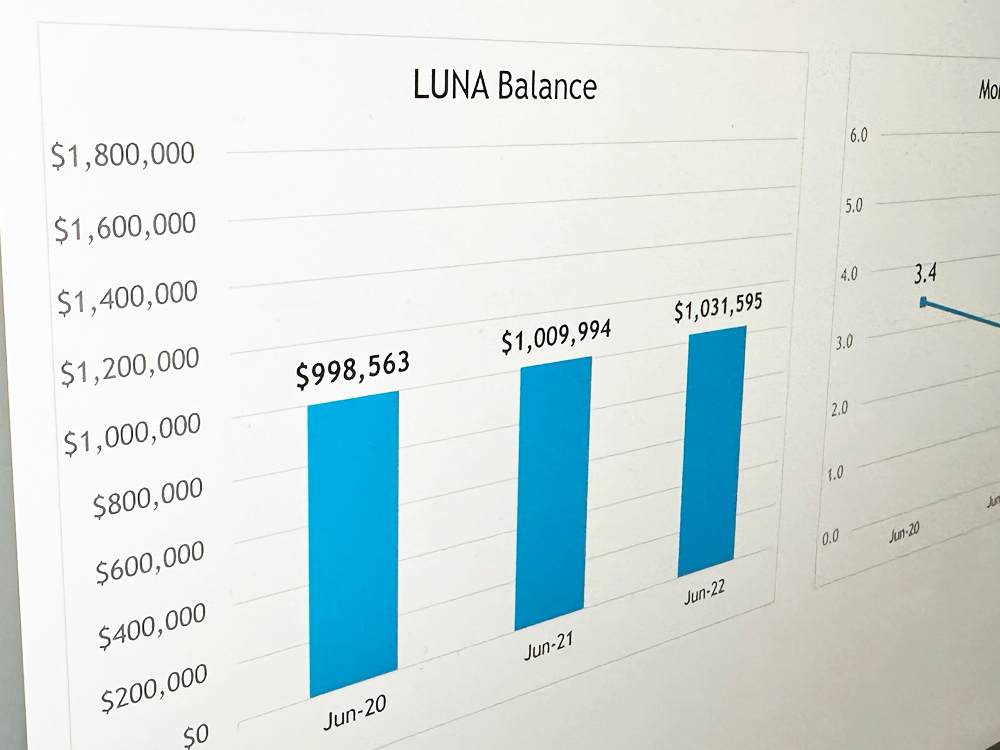
The approach they suggest is to start with LUNA and then work backwards. The purpose of LUNA, Polanco explained, is capital for weathering expected and unexpected gaps in funding—and for many funders and nonprofits, it’s a key indicator of financial health. “It’s about savings, and it’s about flexibility. How many months of operations can the organization cover?” For example, LUNA is critical for nonprofits that depend on funding from the government, whose payments can often be delayed, and to be able to continue operating given a sudden loss of funding. The LUNA formula is total liquid net assets—that is, not counting facilities or property owned—divided by the organization’s monthly expenses.
The question for grantmakers to consider, said Polanco, is, “How many months of LUNA would you want your grantees to have? Does that figure cover the full budget or the full budget minus the program expenses that they wouldn’t incur if they didn’t have a grant?” She made clear that “this is a point of conversation,” and that insufficient LUNA shouldn’t disqualify an organization from being funded. “Quite the opposite: An organization with less than three months of LUNA may need an unrestricted grant or flexible program spending. It’s about how the funder supports the nonprofit’s ability to have those reserves over time.”
Liquidity, or cash on hand, must be looked at alongside LUNA. This measure includes restricted funds as well as unrestricted funds, which may make an organization appear more liquid than they actually are. On the other hand, said Polanco, “you may have a LUNA balance that’s higher than [the number of months your liquid assets will last] because there are receivables coming in that haven’t been collected. That’s why we look at both.”
You can review operating results using an organization’s statement of activities. The fiscal results for a given year—surplus or deficit—are calculated by subtracting expenses from unrestricted revenue. The question, according to Polanco: “Over time, is the organization generating enough revenue, less expenses, to increase their net assets? Starting LUNA plus the surplus or deficit equals ending LUNA.” Looking at this calculation over a number of years, you can get a sense as to whether the organization’s financial situation is trending upward or downward. Organizations need surpluses to build reserves.
Considering the cases
A nonprofit’s LUNA trends should always be used as fuel for a conversation—even if there’s a deficit. In these cases, a funder can explore the idea of a strategic deficit as a way to invest in growth over time, such as for hiring the organization’s first development director. “From your perspective as a funder, you’re wondering what is the return on investment of that deficit over time,” Polanco said.
However, a common fear among nonprofit leaders is that if their organization is operating at a surplus, that will signal that they do not need more funding. Polanco encouraged the audience to coach nonprofits away from this fear by framing surpluses in a different light: “Surpluses count toward sustainability, and operating at a surplus is a nonprofit’s decision to strengthen it’s financial health” she said. “Nonprofits want to be an investment that funders feel comfortable making.”
Polanco said that a truly balanced budget—which she has never encountered herself—would point to two possible strategic explanations. “Either they’re working really hard to spend every dollar they raise, or they’re raising just enough to cover their operating costs.” Neither one is “something that a leader would ever say, or that you as a funder would want,” which, again, is a conversation prompt—not a dealbreaker. Instead, ask the nonprofit to help you understand how you came to that perfectly balanced budget.
“One idea we are hoping you take with you: If a growing nonprofit has a goal of three or six months of LUNA, that target LUNA number will become larger as the organization’s budget increases each yeary,” added Polanco. In other words, the organization needs to ensure the LUNA balance grows at the same pace as their budget. You don’t want a grantee to outgrow their reserves. One way of addressing this is including a budget line that speaks to the need to increase operating reserves as part of an overall growth campaign budget.”
“Nonprofit leaders really need to strike a critical balance,” added Pedroni. “If you’re only focused on how much LUNA a nonprofit has, and you’re not thinking about the other aspects of the organization , that could also be a challenge.” In addition to financial health, she points to a number of factors that add to organizational strength and equity: thriving wages and benefits, wellness programs, professional development, facilities, technology, and cybersecurity. “You need to take a holistic approach in your review and conversations.”
Meet the Author

Marc Schultz
Contributing Writer
Principles for Peak Grantmaking
Read more insights related to this Principle:
Narrow the Power Gap
Related Topics
Grantmaking LifecycleRisk, Finances & Compliance
Related Articles
Beyond Annual Renewals: How Multiyear GOS Changes Grants Management
READ
Rethinking Indirect Cost Rates to Support Nonprofit Financial Health
READ
The Ultimate Guide to Automation in Grants Management
READ