Launched in 2019, the Disability & Philanthropy Forum has been a philanthropy-mobilizing organization dedicated to advancing disability inclusion, rights, and justice through education and programs. And as its inaugural executive director, Emily Harris has grown the staff to a team of seven professionals who are strategically advancing the vision for a disability-focused philanthropic network. Their work is making disability inclusion a priority and highlighting the lack of funding in this area as a crisis. The Disability Inclusion Pledge has created a peer network of over 90 foundations and philanthropy-supporting organizations committed to learning together and taking action to center the perspectives of disabled people in their social justice work. As part of her three-pronged strategy, Harris has engaged foundation CEOs to build awareness and grow the movement.
On July 1, Harris retired and passed the leadership torch to Sandy Ho, who previously served as program director of the Disability Inclusion Fund at Borealis Philanthropy. PEAK is delighted to welcome Sandy to the role as we reflect on Harris’s leadership and the need for the philanthropic sector at large to better champion disability inclusion. PEAK President and CEO Satonya Fair sat down with Harris as part of our ongoing CEO:CEO series. Highlights from their conversation follow.
Fair: You have not always been in this disability rights space. How did your career journey lead you to the Disability & Philanthropy Forum?
Harris: I had worked for most of my career in urban planning starting in historic preservation and then moving to open-space and nature conservation and economic development. I then segued to strategic planning for nonprofits because that was the common thread in each of those roles. And through that, I ended up doing a lot of work in early childhood education policy, workforce development and developed interests in economic growth.
In 2009, the Chicago Community Trust funded a centennial celebration of architect Daniel Burnham, who created the urban plan for modern Chicago. I worked with city leaders to organize a massive regional event. Fast forward to 2014 and the organization I worked for was sunsetting. I talked to the head of the Chicago Community Trust, who had been approached by leaders from the disability community about celebrating the 25th anniversary of the Americans with Disabilities Act and to get philanthropy to stop saying “we don’t fund disability.” That brought me together with the disability community leaders here in Chicago and we engineered a program that asked the region: What can you do to move towards better accessibility and inclusion. That was when I discovered my personal and professional passion. I had been hard of hearing for 20 years and had never seen myself as part of the disability community or understood the value of the disability rights and justice movement for me.
I was able to stay at Chicago Community Trust and incubate a legacy project called Disability Lead, a leadership program for disabled people that connects them to opportunities in the public sector, on task forces, and on nonprofit boards. The Ford Foundation then called me to be a consultant for their Presidents’ Council on Disability Inclusion in Philanthropy, which became the Disability & Philanthropy Forum.
Fair: In reflecting on your career transitions, who were the champions who helped you along the way?
Harris: Terry Mazzini, who was then the CEO of the Chicago Community Trust, was passionate about disability inclusion and really had done a lot at the trust. There was a disabled board member, Jack Catlin, who was an incredible architect, who really was a national expert on universal design. And so, I learned a tremendous amount from the two of them. And then, the disability rights leader Marca Bristo, who co-chaired the ADA 25 Chicago Celebration. Marca had been the chairperson appointed by Bill Clinton to the National Council on Disability and essentially wrote the regulations to implement ADA and created Access Living, which is one of the 403 Centers for Independent Living in the United States. My guiding folks have also been those who have brought the movement towards disability justice, bringing voices of queer and BIPOC disabled people to the forefront.
Fair: Personally, I have been highly motivated from a conversation I moderated at the Disability & Philanthropy Forum’s invitation with activists Daphne Frias and with Dom Kelly. In hearing each of their stories as we prepared, I found my own new passion for how I take ownership of my own health struggles that I have hidden from my work community for fear of how people would take my truth. I realized I had to adjust and be more honest with what I needed to be successful at work.
That said, how do you mobilize funders to operationalize and incorporate disability inclusion into their grantmaking practices?
Harris: As you just articulated, we have to start with ourselves. Philanthropy’s history with disability rights and justice is rooted in pity and the idea that people with disabilities need to be moved to the side or fixed rather than embraced as a natural part of the human experience.
The Disability & Philanthropy Forum has three strategies based on an understanding that disability isn’t separate from other issues. We start with learning, which we foster by providing resources—webinars, our website, podcasts—and by trying to create conversations. Our second strategy is peer networks—creating opportunities for people to continue learning together and from each other. And our third strategy is philanthropic advocacy. We think of that in terms of advocating to the sector, advocating with the sector, and advocating with disabled leaders and the disability community within the philanthropic sector. Here, we support funding by doing research to show just how low the amount of funding for disability rights and justice is—only 1/10 of 1 percent of US grantmaking—to make that kind of systems change. Our philanthropic advocacy also includes trying to raise money for intermediaries like the Disability Inclusion Fund at Borealis and making sure that even if foundations aren’t ready to increase their own grantmaking, they’re getting dollars out through other initiatives. We’re also starting to dip our toes into helping those in the sector who are active in policy to understand where disability policy fits in.
Fair: What have been the barriers?
Harris: The biggest one is inherent ableism in philanthropy and in society. It’s important to look within and understand our own history from the point of view of disability and when—or if—philanthropy ever counted ableism among the intersecting systems of oppression it’s trying to disrupt.
There is also a broad misunderstanding of how people with disabilities are taken care of—or not. The ADA’s passage in 1990 was a watershed moment, but it’s challenging to enforce. We have to sue to get our accommodations. Many think that the government is continuously watching and working on our behalf, so philanthropy has thought that it doesn’t need to intervene.
Another barrier is the idea that we were operating in a normal system pre-pandemic. In rushing back to the office, organizations are leaving behind all the people who were left behind before.
Fair: To see philanthropy ignore every report that proved the pandemic created the most inclusive employment environment for people with disabilities and walk away from it so quickly was soul crushing for me. What’s giving you hope?
Harris: Doors are starting to open and dollars are starting to move. I see the continually growing number of Disability Inclusion Pledge signatories who are doing the work—almost 90 foundations and philanthropy-supporting organizations that have eagerly signed on, and are grateful for us providing a road map. It’s been exciting to partner with groups like Change Philanthropy on their survey and help them come up with language that allows them to recognize that 25 percent of philanthropic staff have some kind of disability. Previously, it was only 6 percent, and that jump speaks to how disability is now being recognized as a broad umbrella that includes mental health, chronic health conditions, and other conditions people have that they never thought of as a disability.
Fair: A lot of people come into philanthropy waiting for a directive, and at PEAK we’ve been trying to encourage people to assume their own positional authority and be agents for equitable change. What’s your advice for building talent pipelines of better champions for disability justice, and inclusion?
Harris: Part of the problem is that HR professionals are trained to be compliance officers and to protect organizations. There’s continual tension between those legal obligations and what employees really need. We need internal cultures where it’s clear that people are welcome. And when you recognize needs and make it easy to work someplace, you create education opportunities. For example, our Disability Inclusion Pledge recommends including the opportunity to request accommodations on any meeting invitation you send out. Just putting that language out there is a huge flag to anybody who’s disabled that they’re welcome.
Fair: It was so easy for PEAK to make small adjustments. For example, at our annual convening, we didn’t have standing mics in big rooms and had attendees send questions through an app. Was that ever a good idea for us to ask people to walk all the way to the front of a giant room to ask a question? No, there are other ways to do this, and technology can be an equalizer. It’s not that hard but it does require intention. The Disability & Philanthropy Forum gave us that road map and you continuously keep us accountable.
Looking to the future, what’s next for you?
Harris: I have an incredibly intriguing family history story. I am really looking forward to doing some research and maybe even some writing on this intriguing family story.
Fair: I love that you have already plotted your next adventure and that it’s focused inward. What questions for the sector are still sitting with you?
Harris: How do we connect the siloed communities within disability spaces and bring them to the table? How do we ensure that nobody ever goes to a panel where they hear about all these groups collaborating—but disability groups weren’t included? I think the Disability & Philanthropy Forum has a role to play in being that bridge.
Fair: I love this tie between us. I often describe PEAK’s bigger work as being the best match.com for organizations grappling around equitable practices. We could tell you what to do—or we could connect you with people who are a little further ahead who can show you what their path was so you can get to where you need to be. PEAK is always looking for great models for moving hearts and minds to action, and I think you gave us an amazing one. You also gave us a kick in the butt to do something different and better. And it’s taking root in this community. It matters. Thank you so much, Emily and best wishes.
Meet the Author

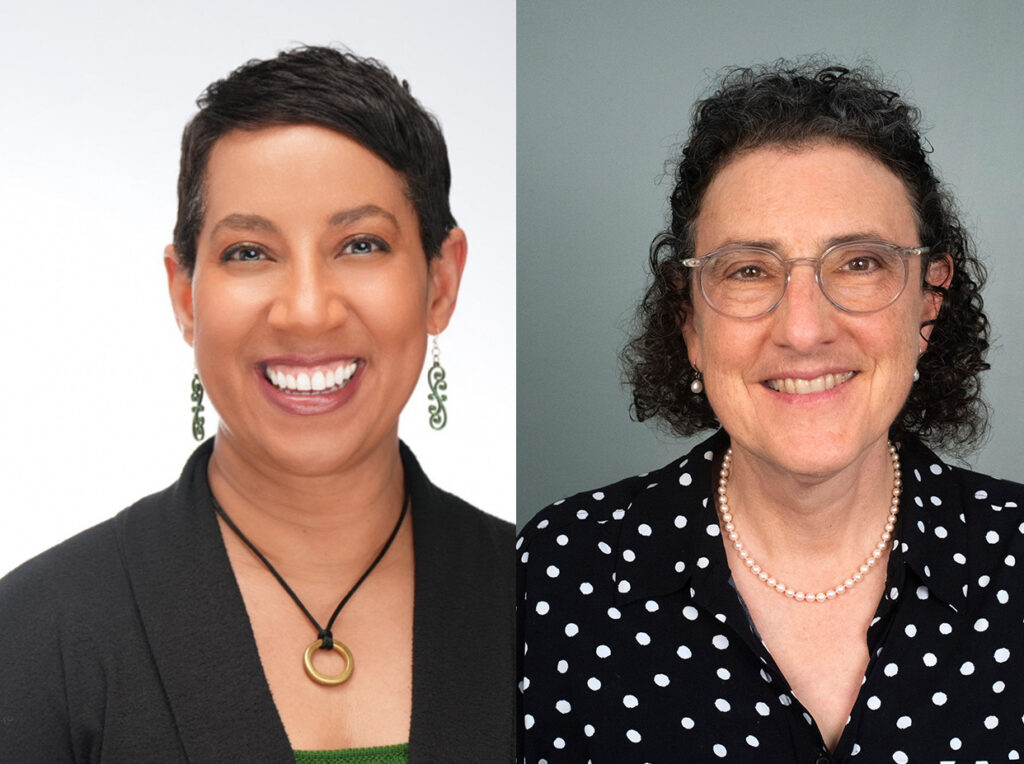
Satonya Fair
President and CEO, PEAK Grantmaking

Emily Harris
Former Executive Director, Disability & Philanthropy Forum
Principles for Peak Grantmaking
Read more insights related to this Principle:
Drive Equity
Related Topics
CEO:CEORelated Articles
Simple Ways for Philanthropy to Move Towards Greater Disability Inclusion
READ
How Disability Inclusion Makes Your Organization Better for Everyone
READ
Inclusive Philanthropy: How to welcome and respect people with disabilities
READ