Technology Rooted in Values: PEAK’s Approach to AI Governance

As a child of the nineties, it is remarkable to consider how rapidly technology has changed in a relatively short amount of time. The kid who hummed along with the staticky internet dialup might look at you funny if you told her that, in just twenty years, robots would be able to deliver groceries straight to one’s door. But now, it’s almost every day that new applications, tools, and platforms are launched promising to solve problems I never knew I had. All these innovations, big and small, have significantly shifted the ways we live and work in this technological age.
The explosion of technological choice can feel overwhelming, especially at work where we are constantly assessing and evaluating what tools can (actually) make our lives easier. So how does one cut through the noise? At PEAK, the operations team does our best to root every conversation and action in our Principles for Peak Grantmaking, namely, tying practices to values.
AI Governance at PEAK
Unsurprisingly, the most top-of-mind technological development we’ve recently considered as an operations team is the role that large language models and generative artificial intelligence would – or should – have in PEAK’s day-to-day operations. The possibilities have certainly been marketed as endless, but the gap between what a technology is said to do and how it actually works can be vastly different things. Rather than jumping in headfirst or making top-down decisions, we opted to take a slower approach that started with understanding staff’s workflows and needs. Everyone may be adopting AI but how does PEAK want to use it?
A few questions we posed:
- Are you using AI tools?
- If so, what are some use cases?
- Does it help you?
- What are your concerns?
The reasons varied but ultimately we heard that most of the team were not interested in integrating AI into their workflows beyond notetaking and meeting summaries. PEAK’s values of learning and partnership ask us to solicit feedback when we can; in this case, staff input was invaluable to validating our instincts that wider AI adoption may not be an immediate operational priority.
Still, even without defined use cases, it is important to develop governing guardrails for acceptable AI use that provide clarity how staff could use AI (i.e. integrated meeting summaries in Zoom; creating generic templates in CoPilot) and they should not (i.e. using free AI tools such as ChatGPT; including sensitive information in prompts).
Embarking on our own learning journey, we read articles, watched webinars, and consulted with peers to see what others were doing within their organizational contexts. Resources and activities, like Allied Media’s Peoples Guide to AI, Consequence Scanning, and Patrick J, McGovern Foundation’s Learning Hub, were among my most frequently-visited sites during this exploration. As a membership association, the throughline of AI usage at PEAK coalesced around empowering staff as subject-matter experts and using AI tools safely, securely, and with consent. In the end, we landed on the following four principles for AI governance at PEAK:
- You are the subject matter expert. AI models may be trained extensively, but staff are ultimately the experts and decision makers. Any use of AI tools should enhance, not supplant, our work.
- Question and verify. AI models are not a perfect technology and, as the subject-matter experts, it’s on us to review, validate, and correct AI results when necessary.
- Prioritize privacy and security. We all have a role to play in safeguarding member data and information, and our guidance clearly defines what information is not appropriate to use in AI models.
- Use AI responsibly and with consent. Because people have different comfort levels with AI, it’s important to ask others for permission before using AI notetakes or recording tools. And, as an organization that values equity, we want to encourage staff to make informed decisions about AI tools, especially considering hidden (and not-so hidden) ethical implications.
Values-based Operations
The other driving force behind these internal deliberations was a conversation about who we want to be as an organization. AI is frequently touted as a productivity tool that can help people work more efficiently, which frees them to do more “more important” work. (What is defined as “important” is a whole other thing to untangle.) But – looking at our internal values to be people-centered and listening to the team’s desires for depth, not breadth – the spirit of more, more, more does not align with who we want to be for each other.
The current world of work prioritizes speed and a “breaking things” ethos over care and maintenance. Burnout, across roles and titles and industries, is quietly accepted as the norm and innovation for productivity’s sake only solidifies burnout-inducing behaviors. As an operations team, we are constantly asking, to what end? To what end do we value pushing capacity and getting more done? What is reasonable for a single person to hold?
And that’s not a theoretical question, either. In January, for example, PEAK piloted its first-ever Planning Month where we considered what our big milestones are for the year and identified potential competing priorities or busy seasons. The leadership team then reviewed everything PEAK has going on and, with staff feedback, made strategic decisions about what projects could be shifted, moved, or negotiated in order to sustainably meet our goals. I suppose one could throw that into a prompt. But it’s the connective element of working together to create an environment where we thrive that is worth preserving.
When we tie our practices to our values, we are thoughtfully encouraging alignment between what we espouse and what we do. If you are curious about AI, or are stuck on how and where to integrate it into your grants management processes, this is a great starting point. Who do you want to be as an organization, for your team, for your partners, for your grantees? What is your desired impact, what is needed to get there, what is already working, and who needs to be brought in? The results might vary from foundation to foundation, which is precisely why we should turn inwards. Context truly matters!
For the PEAK operations team, we will continue to monitor the changing technological environment and assess what opportunities do and don’t make sense for our organizational context. There is a lot of noise out there, but we can meaningfully cut through most of it by grounding our decisions in our values. If you’re interested in reading our Principles for AI Usage at PEAK, feel free to send me an email at kaitlyn@peakgrantmaking.org.
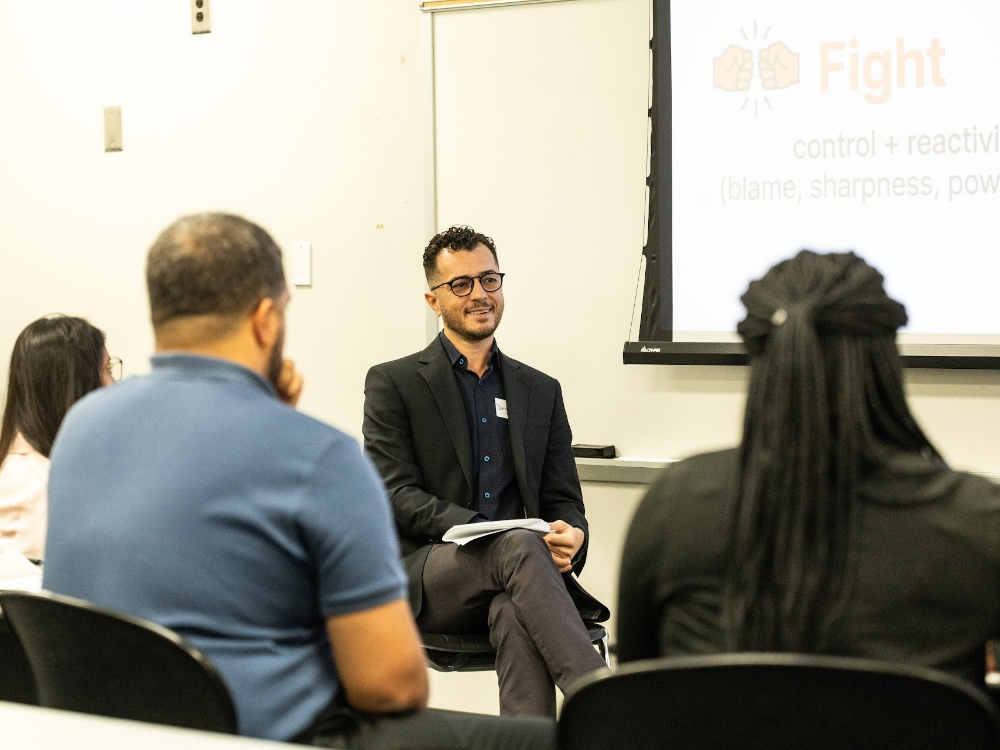
Image Credit: Preeti Singh for CoGenerate x Fine Acts
This image was cropped for size.
Meet the Author

Kaitlyn Borysiewicz
People, Culture, and Learning Manager, PEAK Grantmaking
Principles for Peak Grantmaking
Read more insights related to this Principle:
Tie Practices to Values
Related Topics
Organizational LearningRelated Articles
Adaptability Is Not Optional: Leading through the Age of Uncertainty
READ
Maintaining the Learning Momentum After a PEAK Convening
READ
How a PEAK–BSU Partnership Helped Me See a Career in Philanthropy
READ