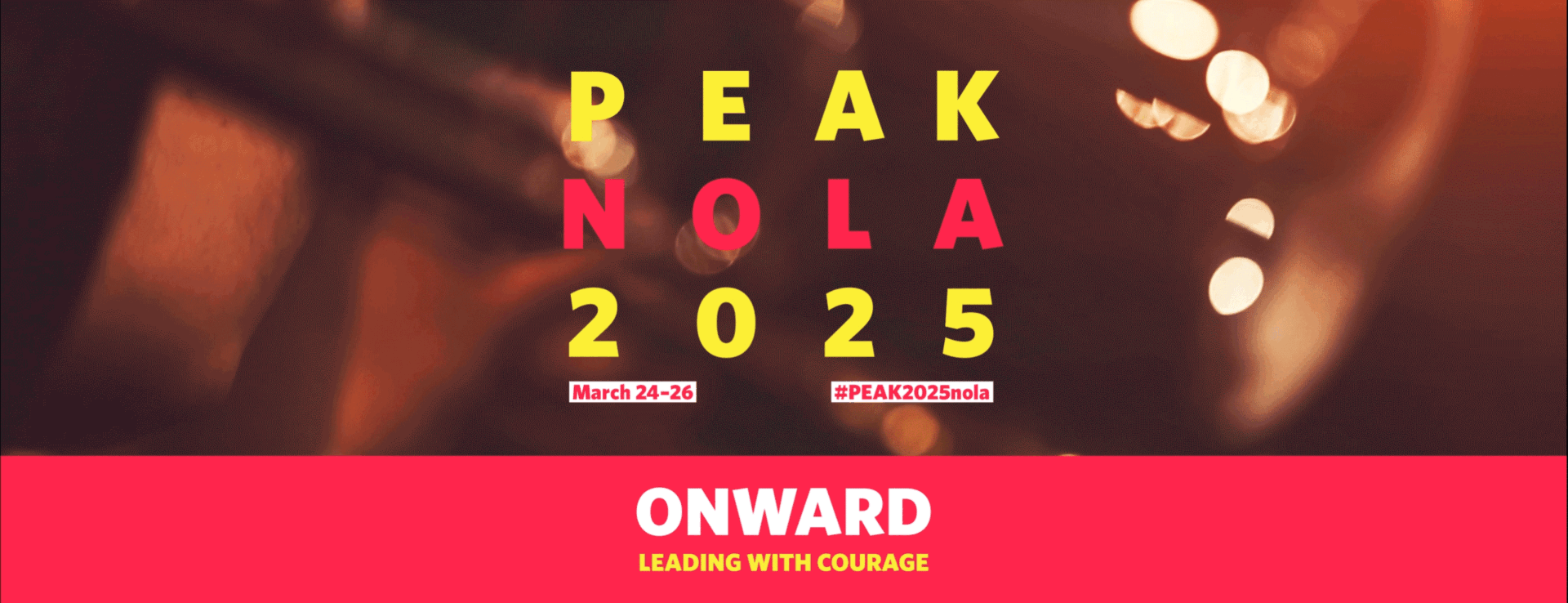
Onward: Leading With Courage at PEAK2025
PEAK2025 is a call for our community to lead, to build on our momentum, and to constructively engage with our feelings of discomfort to transform philanthropy and dismantle systems that disenfranchise people throughout our nation. As individuals and as a collective, let’s lead with courage and boldly move toward a future where justice and equity prevail. To this, we say: Onward!
Get ready to join us March 24–26, 2025 in New Orleans!

AGENDA
Preconvening | Sunday, March 23
Grants Management 101 Hybrid Learning Experience (11:30 a.m.–4:00 p.m. CT)
The GM101 hybrid learning experience includes an in-person training on Sunday, March 23, at PEAK2025 and two virtual learning sessions, one before and one after the convening. The condensed GM101 learning opportunity features large- and small-group discussions with hands-on case study exercises that build participants’ knowledge, know-how, and networks to effect more equitable, values-based grantmaking practices throughout the grant lifecycle. The faculty will include PEAK board members and alums, staff experts, and sector thought leaders who will present on both technical and aspirational elements of this work. Register for GM101 when you register for the convening. The program fee is $500 for Organization Members and Consultant Members and $800 for Individual Members and nonmembers.
Curriculum
- Orientation and Module One: Introduction to Philanthropy
Thursday, February 27, 2:00 p.m.–4:30 p.m. ET: Virtual - Module Two: Embedding Equity throughout the Grantmaking Lifecycle
Sunday, March 23, 11:30 a.m.–4:00 p.m. CT: In-person at PEAK2025 in New Orleans - Module Three: Career Trajectories and Skill Mapping
Wednesday, April 16, 2:00 p.m.–4:30 p.m. ET: Virtual
We thank Temelio and Ascendium Education Group for supporting our Grants Management 101 Hybrid Learning Experience.
Peer Network Volunteer Leader Retreat (12:00 p.m.–4:00 p.m. CT)
On Sunday afternoon, we’ll convene our outstanding chapter and peer group volunteer leaders for our second annual retreat. Participants will develop leadership skills, build personal and professional networks, and join in collective brainstorming to best support and enrich communities of belonging at PEAK. We encourage all chapter and peer group volunteer leaders to attend. Details will be shared directly with volunteers.
Beyond the Numbers: The Art of Data Visualization (1:00 p.m.–4:00 p.m. CT)
Through this workshop, participants will gain essential skills to transform raw data into powerful visualizations that drive informed decision-making, identify trends, and measure impact. Participants will explore various approaches to storytelling with data and the strategies to consider for reaching diverse audiences, from your peers to the directors on your organization’s board. Don’t miss this opportunity to unlock the power of data visualization and elevate your grantmaking practice! Register for this learning experience as an add-on to your PEAK2025 registration. The program fee is $300 for Organization and Consultant Members and $500 for Individual Members and nonmembers.
This workshop will be facilitated by Ann K. Emery, Data Visualization Designer at Depict Data Studio, LLC.
Ann K. Emery is an internationally acclaimed speaker who equips organizations to get their data out of dusty spreadsheets and into real-world conversations.
Each year, she delivers over 100 keynotes, workshops, and webinars with the aim of equipping organizations to visualize data more effectively.
She has been invited to speak in 31 states and 11 countries; 10,000 people have enrolled in her online training academy; and she has consulted to 200 organizations, including the United Nations, Centers for Disease Control, and Harvard University.
She earned a Bachelor’s degree from the University of Virginia and a Master’s degree from George Mason University.
After traveling full-time as a digital nomad, Ann now resides in Florida along with her husband and five children.
Nonprofit Volunteer Opportunities
On Sunday afternoon, experience New Orleans from the vantage point of a local nonprofit and support their work. With support from Maddie’s Fund, we’re excited to partner with The Inner Pup to host a People & Pets Wellness Fair. This event will provide free pet healthcare services as well as personal healthcare resources for individuals. PEAK volunteers will serve as greeters and engage with the community during this event. See the Cvent app for signup information.
Speed Networking (2:00 p.m.–3:15 p.m. CT)
Get to know more of your PEAK colleagues in a series of fast-paced, one-on-one conversations that could spark valuable relationships and new ideas. We’ll offer other opportunities for speed networking on Tuesday.
Disability and Inclusion Hotel Tour (4:00 p.m.–5:00 p.m. CT)
Get a firsthand look at the meeting spaces before the convening officially starts. This guided tour will highlight accessibility features available to ensure our attendees have a comfortable and inclusive experience. You can add the tour to your agenda through our convening app, Cvent.
GM101 Reception (4:30 p.m.–5:30 p.m. CT)
If you’re a Grants Management 101 participant or alum, we invite you to join us for an evening that will help prepare you to make the most of the convening. Reconnect with colleagues, network with other program alums, and meet members of PEAK’s staff and board.
We thank Blackbaud and Annenberg Foundation for supporting our GM101 Reception.
Newcomer Reception (6:00 p.m.–7:00 p.m. CT)
Are you new to PEAK? Is this your first time at our annual convening? Kick off your PEAK2025 experience at this event where you’ll connect with other first-timers, learn more about PEAK, and meet members of our staff and board, as well as our convening cochairs and members of the PEAK2025 planning committee.
We thank GivingData for supporting our Newcomer Reception.
Monday, March 24
Keynote | 9:00 a.m.—10:45 a.m. CT
Courageously Investing in Justice, Resilience, and Community-Led Change
For our opening keynote, Ford Foundation’s Bryttnee Parris will moderate a dynamic conversation between Women’s Foundation of the South President and CEO Carmen James Randolph and Kresge Foundation CEO Rip Rapson, both of whom are deeply engaged in supporting communities in New Orleans. They will be joined by two of their grantee partners – HousingNOLA’s Andreanecia M. Morris and Sankofa Community Development Corporation’s Rashida Ferdinand – who are on the front lines of addressing the complex challenges facing the city’s historically marginalized populations, such as racial inequity, poverty, and the long-term impacts of historical trauma. Together, they will explore the issues and opportunities facing New Orleans, the importance of long-term commitments and courageous grantmaking practices, and share inspiring examples of how funders and grantees are working together to build a more equitable and resilient future for all residents.
We thank Marguerite Casey Foundation, SmartSimple+Foundant, and Salesforce for their support of our keynotes.
Breakouts | 11:15 a.m.—12:30 p.m. CT
Funding Community Movements and Our Democracy for the Long Haul
Join the Tides Foundation and our partners in this workshop session to reflect on how the philanthropic sector showed up for democracy in 2024 and to strategize for 2025 and onward. Though investments in civic engagement and democracy-focused organizations are at an all-time high in response to 2024’s most critical elections, community organizers know that strategizing on state and local levels should not be undervalued or invested in. This is especially important given the visceral state-level battles around social welfare policy, LGBTQ+ rights, and abortion over the past few years.
Regardless of your or your organization’s experience levels with this type of work, tolerance for risk, or cause areas, this workshop is designed to provide learning, community, and, most importantly, tangible examples of ways to support the democratic work that you can bring back to your organization.
By attending this session, participants will deepen their knowledge in the following areas:
- Strategies for supporting democracy work regardless of experience level, risk tolerance, and cause area to bring back to their organizations
- The challenges and needs that grantee partners in the democracy ecosystem doing this work face, especially in years without federal elections
Speakers
Sarita Michaca, Tides
Beth Huang, Tides Foundation
Riley Hewko, Tides Foundation
Julie Terbrock, Missouri Voter Engagement Action
Ten Ways New Managers Can Build Engagement, Trust, and Productivity
High performers frequently get tasked with managing direct reports without formal leadership training or guidance. While rising stars excel at the art of grantmaking, the art of managing people requires additional skills.
Join this workshop to learn 10 management tips that I’ve learned in the last 10 years of facilitating manager training. We’ll cover everything from the mechanics of effective one-on-one meetings to building psychological safety. You’ll walk away with practical resources, templates, and articles to continue building your leadership skills.
By attending this session, participants will deepen their knowledge in the following areas:
- Actionable tips and resources to build influential management skills in their day to day work, including psychological safety, trust, goal setting, addressing bias, performance management, giving and receiving feedback, and delegation
Speakers
Sarah Sprott, Candid
Christopher Percopo, The Leona M. and Harry B. Helmsley Charitable Trust
Everything You've Wanted to Know about Intermediaries
Join this session to better understand fiscal sponsorship and how you can develop policies and procedures for the management of grants to fiscally sponsored projects. Fiscal sponsors can provide a helpful structure to maximize efficiency of grant funding by providing back-office infrastructure to sponsored projects, helping with compliance oversight, and facilitating collaboration across funders. Although fiscal sponsorship is a longstanding practice in the grantmaking and nonprofit community, it is still an area where many grantmakers struggle to understand the nuances of the fiscal sponsorship relationship and how it impacts grants management.
By attending this session, participants will deepen their knowledge in the following areas:
- The fundamentals and common misconceptions about fiscal sponsorship and the challenges that can arise when funding fiscal sponsors
- Practical tips and best practices for grants managers dealing with fiscal sponsors
- Equitable practices within fiscal sponsorship and best strategies to ensure a more diverse and transformational approach to fiscal sponsorship
Speakers
Hayley Smith, Build Up, Inc.
Ajani Husbands, Build Up, Inc.
Aligning Values and Reporting Practices at the Robert Wood Johnson Foundation
Rarely read and often submitted too late to inform strategy, written reports have long been a source of frustration for both foundation staff and grantees. In 2023, RWJF instead asked whether and how reporting could better align with its organizational values and launched the Written Reporting Alternatives Project (WRAP) to investigate and potentially reimagine its approach to narrative reporting to make it more purpose-driven and grantee-centered. This session will explore the development of WRAP and share preliminary findings and reflections.
By attending this session, participants will deepen their knowledge in the following areas:
- How to align reporting practices with values
- Grounding practice change in participatory research
- The barriers and rewards of changing reporting practices across the field
Speakers
Indya Hartley, Robert Wood Johnson Foundation
Monique Shaw, Robert Wood Johnson Foundation
Jessica Bearman, Bearman Consulting, LLC
Collective Care and Healing for Movement Practitioners
Learn about Who Keeps the Keeper (WKTK), a program that uses restorative practices to equip frontline workers and movement leaders who are Black, Indigenous, and people of color (BIPOC) with tools to create and sustain a healing culture. Trinity Church and the BREATHE Collective, one of their grantees, developed WKTK to answer the fundamental question within their collective: Who takes care of those dedicated to repairing the fabric of our communities, healing the wounds of injustice, and driving transformation? The program seeks to address the pervasive issues of burnout, turnover, and isolation in the nonprofit sector and demonstrate how the philanthropic sector can use capacity-building offerings to ensure the success of grantee organizations.
By attending this session, participants will deepen their knowledge in the following areas:
- How restorative and healing justice can be tools to promote self and community care
- How investing in BIPOC leaders and movement practitioners is critical to the success of grantmaking institutions
Speaker
Cheavanese Diedrick, Trinity Church NYC
Building a Healing-Centered Culture to Reduce Burnout
This immersive workshop is designed for philanthropy leaders and managers grappling with the increasing burnout concerns in the social sector. Speakers will guide attendees through an experience to better understand how survival patterns can lead to burnout, equipping them with the awareness to recognize these patterns within the workplace. Attendees will explore the principles of a healing centered culture to encourage collective empathy, resilience, and restoration. Learn about supportive tools and techniques for managing teams and harmonizing the demands of philanthropic work with sustainable well-being practices.
By attending this session, participants will deepen their knowledge in the following areas:
- Discover how your unique survival archetype perpetuates burnout.
- Techniques to build a healing-centered culture for leadership and team culture strategies.
- Explore sustainable approaches to manage personal and team burnout.
Speakers
Manuela Contreras, Con Fuerza Experiences
Nicole Torres, Ouroboros Healing
Let's Talk About AI as Our Next Coworker
In this discussion, Kristin Pazulski and Richelle Pittella of the Artificial Intelligence (AI) for Grantmakers Forum will facilitate a conversation about the fundamentals of AI and its growing impact on the philanthropic sector. We’ll demystify how AI works (and doesn’t work) and explore potential uses of this technology in the workplace. Participants will hear practical examples of how AI can enhance processes such as writing, data analysis, reporting, and have the opportunity to share their own. This session is aimed at those at the early stages of AI use to help provide a solid foundation for incorporating this technology into their workday.
By attending this session, participants will deepen their knowledge in the following areas:
- Learn about examples of how your peers in philanthropy have used AI-enabled tools in the workplace.
- Learn more about how common AI tools, like learning language models, generate responses, and explore key considerations.
Speakers
Richelle Pittella, Conrad N. Hilton Foundation
Kristin Pazulski, The Louis Calder Foundation
Shifting Power by Letting Grantees Lead Strategy Development for Impact
This session brings together Annie E. Casey Foundation–Atlanta Civic Site, grantees, and consulting firm Community Build Ventures (CBV) to explore how this unique collaboration led to a transformative strategy designed to empower grantees. In 2024, the foundation made a bold move by yielding its power and stepping aside, allowing grantees—those closest to the challenge of retaining and sustaining effective Black male educators in Atlanta—to drive the strategy development process. Grounded in racial equity, this approach ensured that the ideas and priorities reflected the needs of the community. CBV designed the framework and facilitated the process, ensuring that grantees remained at the heart of decision-making.
By attending this session, participants will deepen their knowledge in the following areas:
- Grantee-led strategy development approaches grounded in racial equity
- Effectively partnering with consulting firms to support grantee leadership
- Shifting power dynamics, allowing grantees to drive solutions
- Building capacity to apply these practices and foster more equitable and inclusive philanthropic strategies
Speakers
Natasha Harrison, CommunityBuild Ventures (CBV)
Rubye Sullivan, The Annie E. Casey Foundation – Atlanta Civic Site
Trust-Based Grantmaker Confessional
In this session, we’ll navigate the challenges of implementing trust-based grantmaking practices and support each other’s journeys to evolve and improve by creating a brave space to share where we and others have tried and failed. We will explore the causes of failure in our work and invite participants to bring their own experiences and examples and engage in an open, nonjudgmental discussion to learn from past mistakes and so that we may find collective momentum to keep pursuing equity in our work.
By attending this session, participants will deepen their knowledge in the following areas:
- Building an understanding of the variety of challenges of trust-based grantmaking
- The experiences of others working to implement trust-based practices
- How we can improve our practices and avoid the pitfalls others have faced so that we can continue to increase equity in our philanthropic practices
Speakers
Chase Williams, GlobalGiving Foundation
Oswaldo Alvizar Bañuelos, GlobalGiving Foundation
Peer Network Meetings | 12:45 p.m.—2:00 p.m. CT
Queer Joy in Philanthropy (PEAK LGBTQ+ Caucus)
With increasing anxiety around the state of the world, we are excited to come together and provide a space for our community to be vulnerable, share joy, and discuss ways to address concerns surrounding our grantee communities as well as our personal and professional lives. There will be significant time allotted for smaller group discussions on a variety of topics so that folx can have the opportunity to get to know one another better and connect on issues that are most important to them at the moment. We look forward to meeting with you!
We thank Surdna Foundation for supporting our Peer Group Meetings.
Lessons from the Racial Equity in Philanthropy Fund and the Future of Intermediary Grantmaking on Sunsetting With Purpose (Intermediaries Affinity Group)
The Racial Equity in Philanthropy (REP) Fund at Borealis Philanthropy is sunsetting after seven years of supporting philanthropy-supporting organizations working to define or expand their racial equity efforts across the sector. The journey of this fund is both nuanced and unique but offers several valuable lessons for funders of all kinds working to implement social justice-centered grantmaking and understand what it truly takes to do this work well.
Several stakeholders will join the conversation to explore the challenges and successes of the REP Fund in relation to Borealis, donors, and grantee partners.
We thank Surdna Foundation for supporting our Peer Group Meetings.
Breakouts | 2:15 p.m.—3:30 p.m. CT
Empowering Grantees Using Flexible Funding for Programs
Join this session to explore how flexible funding for programs offers an alternative to traditional, more limiting, grantmaking practices, providing the necessary funding for specific programs or projects within an organization while allowing the grantee flexibility in how they use the grant funds. This approach empowers grantees to direct resources where they are most needed, whether addressing unexpected challenges or seizing new opportunities, without the worry of requesting budget modifications.
By attending this session, participants will deepen their knowledge in the following areas:
- An understanding of what flexible funding for programs is and how it differs from project and general operating support grants
- How flexible funding for programs helps organizations achieve their mission with greater flexibility, resilience, and sustainability
- How to implement this approach in your own grantmaking practices, through case studies and practical insights
- How flexible funding for programs can help social justice funders shift the power dynamics in grantmaking and drive equitable, justice-centered outcomes
Speakers
Rokeya Rahman, Mellon Foundation
Nora Mitnick, Mellon Foundation
Carly Benkov, Ford Foundation
Jim Gallagher, Ford Foundation
How Beliefs-Aligned Leadership Can Transform Philanthropy
In this interactive fishbowl conversation, we will explore how beliefs-aligned leadership, embedded within clear organizational structures, can drive transformation within the philanthropic sector. Moderated by Marguerite Casey Foundation Chief Human Resources Officer Hannah Nichols the session will open with insights from representatives from the Marguerite Casey Foundation and William & Flora Hewlett Foundation as they share their journeys navigating leadership in philanthropy, before transitioning into a dynamic fishbowl format.
Attendees will have the opportunity to engage in a meaningful discussion about what it takes to not just lead, but lead in alignment with your core beliefs, and help shape a more just and inclusive sector for all.
By attending this session, participants will deepen their knowledge in the following areas:
- How belief-aligned leadership can transform the philanthropic sector
- Strategies that help drive equity focused, impact-drive, inclusive teams
- Practical tools and examples to influence culture, advocate for equity, or rethink your leadership style
Speakers
Zeeba Khalili, Marguerite Casey Foundation
Hannah Nichols, Marguerite Casey Foundation
Amanda Lanceplaine, The William and Flora Hewlett Foundation
Empowering Indigenous Self-Determination in Philanthropy
Join this session to learn how the NDN Collective, alongside key partners, is revolutionizing philanthropy by placing Indigenous leadership and self-determination at the core of its grantmaking strategies. By dismantling traditional philanthropic power structures, NDN Collective’s model transfers decision-making authority directly to Indigenous communities, ensuring that those most impacted are driving the solutions. Grounded in the principles of Defend, Develop, and Decolonize, their approach emphasizes long-term, flexible funding that empowers community-led initiatives, fosters wealth-building, and promotes self-sufficiency.
By attending this session, participants will deepen their knowledge in the following areas:
- How Indigenous-led, community-centered grantmaking challenges traditional philanthropic models
- Practical strategies for shifting power and decision-making to historically marginalized communities, fostering equitable partnerships, and implementing trust-based funding.
- An enhanced capacity to advocate for and integrate decolonized, equity-driven approaches into their own philanthropic practices
Speakers
Christina Chavez, NDN Collective
Nicole Maria Yanes, NDN Collective
Gabrielle Strong, NDN Collective
Melina Laboucan-Massimo, Sacred Earth Solar
Funding Grassroots Organizations to Advance Equitable Grantmaking Practices
Research demonstrates that smaller nonprofits, especially those led by people of color, often lack the infrastructure and resources necessary to compete for large foundation grants. Join this session to hear from two grants managers from the Nina Mason Pulliam Charitable Trust on how their foundation started a pilot program to provide grants to grassroots organizations and other small nonprofits. They will share the background research they conducted, how they incorporated trust-based grantmaking concepts into the program, what they have learned so far in the pilot program, and future questions they hope to address as the program continues.
By attending this session, participants will deepen their knowledge in the following areas:
- How to implement a grassroots grantmaking program to help their organizations practice more equity-centered grantmaking
- The value of trust-based grantmaking
Speakers
Josh Abel, Nina Mason Pulliam Charitable Trust
Rachel Weaver, Nina Mason Pulliam Charitable Trust
Maximizing Data as an Asset for Equity
Foundations have the money, relationships, and convening power they need to advocate for change, but are they leveraging another crucial asset—data—for good? Native Ways Federation Executive Director Carly Bad Heart Bull and a representative from Allegany Franciscan Ministries will join Candid CEO Ann Mei Chang for a compelling session on how funders and funder consortiums can get the most out of data to support informed and equitable grantmaking decisions. Their discussion will explore how data-driven practices are critical for improving accessibility, accountability, and transparency in the nonprofit sector, but only if the practices are developed with community direction and input.
By attending this session, participants will deepen their knowledge in the following areas:
- Addressing challenges and implementing changes to create a more equitable philanthropic landscape
- How alignment on data standards, collaborative data sharing, and better grant data coding for specific groups can highlight funding gaps and support equitable, data-driven giving.
- How to leverage nonprofits’ Candid profiles for demographic data collection and assessment strategies
Speakers
Ann Mei Chang, Candid
Carly Bad Heart Bull, Native Ways Federation
Brittney Frazier, Alleghany Franciscan Ministry
Navigating Equivalency Determination With NGOs
Learn about the tools you can use to predetermine if an organization is suited for equivalency determination or expenditure responsibility and how to prepare and support nongovernmental organizations through the equivalency determination process. The presentation will be followed by a Q&A.
By attending this session, participants will deepen their knowledge in the following areas:
- Tools and approaches foundations and NGOsource have developed to help grants managers work with program staff to determine whether to use equivalency determination or expenditure responsibility
- What to ask during the pre-vetting decision-making process that precedes equivalency determination
- How working with a local partner can ensure a localized approach
Speakers
Jonathon Fairhead, TechSoup Global/NGOsource
Mirela Gegprifti, Hillspire LLC
Writing Standard Operating Procedures
Are you struggling to document your organization’s complex processes and keep them up-to-date? In this interactive session, five foundations of various sizes will share their approaches to documentation and offer practical tool and tips, and then lead an exercise aimed at developing your process documentation skills. Then, participants will have the opportunity to apply these next-level practices by starting to draft process SOPs. You’ll leave with a practical roadmap for creating a process document tailored to your organization’s grantmaking procedures.
By attending this session, participants will deepen their knowledge in the following areas:
- Awareness of different types of documentation and tools to support each type
- Process mapping and how to create detailed, step-by-step documentation
Speakers
Mary Kadzielski, Philanthropy. io
Astrik Tenney, Strada Education Foundation
Jen Ruffner, Summit Foundation
M.J. Thorne, The Goizueta Foundation
Aaliya Ahmed, Quadrature Climate Foundation
Go the Extra Mile for Grantees by Rethinking Site Visits
Join this interactive workshop where New Breath Foundation and grantee VAYLA-New Orleans share five tips on how to center equity, inclusivity, and accessibility when approaching grantee site visits in ways that level problematic power dynamics, focus on the grantee experience, and build relationships rooted in trust.
By attending this session, participants will deepen their knowledge in the following areas:
- The key components of what makes a site visit valuable for grantee and grantmaker alike
- How to use a trust-based and participatory grantmaking framework to shift your practice of site visits to be more equitable, inclusive, and valuable approach
- How to strategically approach site visits going forward
Speakers
Claudia Leung, New Breath Foundation
Jacqueline Thanh, VAYLA New Orleans
Anthony Johnson, VAYLA New Orleans
Spark Change With a Little Fire: Busting myths about conflict
By steering clear of the discomfort that can come with conflict, organizations make dissent and unique ideas uncomfortable and focus too much on consensus. When that happens, organizations may miss opportunities to innovate. In this session, the Walter & Elise Haas Fund will bust five common myths about conflict as they share their continuous journey in making major innovations in its grantmaking strategy. Participants will also learn practical tools to bring constructive conflict back to their organization. If you’re looking for tools to help you disrupt the status quo and support change management, this session is for you.
By attending this session, participants will deepen their knowledge in the following areas:
- How to develop a useful definition of conflict
- The connection between innovation and conflict in the nonprofit sector
- How to assess the prerequisites for healthy conflict, focusing on power imbalances and toxic organizational cultures
- Tools to help harness the power of creative conflict and resources for more tools
Speakers
Betsy Block, B3 Coach
Jamie Allison, Walter & Elise Haas Fund
Chapter Meetings | 4:00 p.m.—5:15 p.m. CT
Let's Connect in NOLA! (PEAK Delaware Valley)
The Delaware Valley team is excited to announce our upcoming journey to PEAK2025 in NOLA, where we will focus on fostering meaningful connections, networking opportunities, and collaborative discussions. We invite you to join us for an engaging afternoon dedicated to building relationships with fellow professionals in the philanthropic sector. This event will provide an excellent platform for exchanging ideas, sharing best practices, and exploring potential partnerships that can enhance our collective impact. Don’t miss out on this chance to connect with peers who are equally passionate about making a difference in our communities.
We thank May & Stanley Smith Charitable Trust and Archstone Foundation for supporting our Chapter Meetings.
Building Transformational Partnerships Around Trust and Service (PEAK Greater Washington, DC)
Join us for a discussion with the American Red Cross Community Adaptation Program’s Terrebonne Parish field team. We will learn how Dr. Gilda Brown Ebanks, Dr. John Navy, and Ryan Sims-Gilkey have created lasting, trust-based relationships in Terrebonne Parish, Louisiana and beyond. This panel discussion will explore the team’s key successes and challenges in addition to their approach to building relationships with nonprofit partners.
We thank May & Stanley Smith Charitable Trust and Archstone Foundation for supporting our Chapter Meetings.
Mixtape Mash-Up (PEAK Mideast)
Let’s talk about remixing foundation practices and systems and dance to our own principled, and equity-centered mixtape! Come to the PEAK Mideast chapter meeting mash-up where we will discuss burning topics at your foundation. Come to this safe and open space to share your thoughts and learn from each other.
We thank May & Stanley Smith Charitable Trust and Archstone Foundation for supporting our Chapter Meetings.
Chapter Meeting (PEAK Midwest)
Join us to network and celebrate our incredible group of members in the Midwest region. Additionally, we will be hearing from leaders of GrowDat, a New Orleans nonprofit, to learn more about the work they do and the role of philanthropy and nonprofits in the Southeast region. We look forward to seeing you there!
We thank May & Stanley Smith Charitable Trust and Archstone Foundation for supporting our Chapter Meetings.
What's Up (PEAK New England)
Join us to catch up on the latest hot topics, debrief on our mentorship pilot program, including testimonials from both mentors and mentees, discuss how to articulate your grant’s evaluations and impacts, and make time for member networking. As always, bring any questions or issues you may need help with as we will have the best and brightest minds in the room!
We thank May & Stanley Smith Charitable Trust and Archstone Foundation for supporting our Chapter Meetings.
Who Are We, and What Is On Our Minds? (PEAK Northeast)
Join us in NOLA for bonding, thinking, talking, and fun! We’ll talk about who we are, select the major topics that will shape PEAK Northeast’s future, and discuss the heck out of them. Candy and salty snacks will be provided—and maybe ballroom dancing.
We thank May & Stanley Smith Charitable Trust and Archstone Foundation for supporting our Chapter Meetings.
Networking and New Orleans Trivia (PEAK Northern Plains)
Join us for some speed networking to make connections and get to know each other better. We’ll cap our time off with a trivia game to get to know New Orleans better, too. We promise fun and semi-fabulous prizes!
We thank May & Stanley Smith Charitable Trust and Archstone Foundation for supporting our Chapter Meetings.
Connections and Career Paths (PEAK Pacific Northwest)
Join your fellow PEAK Pacific Northwest members from across Alaska, Guam, Hawaii, Idaho, Montana, Oregon, and Washington for our annual chapter meeting. We’ll connect within our chapter and learn about the best work we’ve done for partner organizations in the past year. We’ll have a facilitated conversation about staff structures and grants management staffing and career trajectories in grants management. We’ll close by checking in about what you want from our regional chapter and how the chapter’s volunteer leadership can help.
We thank May & Stanley Smith Charitable Trust and Archstone Foundation for supporting our Chapter Meetings.
Networking Do-Sa-Do (PEAK Rocky Mountain Chapter)
Join us for in-person speed networking with some Rocky Mountain flair at PEAK2025! Attendees will have a chance to reunite with colleagues and make new connections.
We thank May & Stanley Smith Charitable Trust and Archstone Foundation for supporting our Chapter Meetings.
Bayou Brilliance (PEAK Southeast)
Join us for a dynamic session exploring the critical role philanthropy plays in disaster preparedness, response, and long-term recovery. This session will feature case studies from organizations in New Orleans and the surrounding region, a hub of resilience and innovation in the face of challenges. Discover strategies to collaborate with local communities, maximize resources, and ensure sustainable recovery efforts. Attendees will gain actionable insights and tools to enhance their disaster-related grantmaking practices and foster meaningful change.
We thank May & Stanley Smith Charitable Trust and Archstone Foundation for supporting our Chapter Meetings.
Can I Sit Bayou? (PEAK Northern California and Southern California)
Join peers from the PEAK Northern California and PEAK Southern California chapters for networking, fun, and games!
We thank May & Stanley Smith Charitable Trust and Archstone Foundation for supporting our Chapter Meetings.
Strengthening our Florida Community (PEAK Florida)
Connect with your fellow PEAK Florida members and help us plan for 2025 and beyond. We will spend time getting to know each other better and find ways for us to support each other in the face of changing and challenging policies. We will discuss how to include perspectives not only from foundations, but also leaders from the fields of corporate philanthropy and governmental grantmaking. To ensure chapter leaders deliver on what is most useful to our members, we will also review upcoming events and ideas for future learning and connection.
We thank May & Stanley Smith Charitable Trust and Archstone Foundation for supporting our Chapter Meetings.
Leading with Courage in Challenging Times (PEAK Southwest)
In the past few years, the South has taken a prominent role in driving our national agenda. Those of us working in the Southwest region are at the center of a cultural shift that calls on us to deeply reflect on our role in leading with courage. During this meeting, members will get to know one another through small group discussions on three of the key roles we play:
- Leading collaboration internally with our teams and externally with other funders
- Leading locally with our partners in the community
- Leading in the changing diversity, equity, and inclusion environment
This meeting will also include an introduction to your 2025 Southwest Chapter Steering Committee and a preview of our plans for the year.
We thank May & Stanley Smith Charitable Trust and Archstone Foundation for supporting our Chapter Meetings.
Tuesday, March 25
Peer Network Meetings | 7:30 a.m.—8:45 a.m. CT
Cafecito y Conexión (PEAK Latinx Caucus)
Building community is in our DNA! Join the PEAK Latinx Caucus to strengthen our community ties and collective learning through speed networking. Caucus members will get the chance to engage with one another in an informal setting and gain an expanded network of colleagues who are passionate about philanthropy and help move money to good places.
We thank Surdna Foundation for supporting our Peer Group Meetings.
Growing as Leaders in Grants Management (Small Foundations Affinity Group)
As leaders grow, their focus often shifts from cultivating themselves to cultivating their teams and getting the work done. In this interactive and collaborative session, learn new frameworks for your development, from reflecting on how you want to grow to making a greater impact on your organization and community by amplifying your skills, strengths, and lived experience. In addition, you will learn how to create supportive systems of accountability as well as tips and tricks to use with LinkedIn. The conversation will focus in part on those who, historically, have been faced with additional career barriers—namely people of color, women, and working parents—and will include time to respond to questions from participants.
We thank Surdna Foundation for supporting our Peer Group Meetings.
Keynote | 9:00 a.m.—10:30 a.m. CT
What Is Required in This Moment?
With so much happening politically, organizationally, and socially, have you stopped to decide how you want to show up in the world right now? For our second keynote, Memphis Music Initiative President and CEO Amber Hamilton will challenge us to examine and explore how we, as individuals and as a sector, decide if we are willing to work together towards bigger impact, or whether our old ways of being are enough to meet the moment. Join us for this moment to connect, laugh, bond, and fortify each other as we navigate a pathway forward.
We thank Marguerite Casey Foundation, SmartSimple+Foundant, and Salesforce for their support of our keynotes.
Breakouts | 11:00 a.m.—12:15 p.m. CT
Around the World in (Almost) 80 Minutes
This collaborative session will explore the constantly evolving international grantmaking landscape. Whether you’re new to global funding or a seasoned pro, come ready to share how you’re creating accessible calls for proposals or supporting grantees in multiple languages, discuss payment logistics and show off how many SWIFT codes you have memorized, and take a deep dive into ED, ER, FCRA, CFR, OFAC, CLABE, or whatever new acronym there is this week. (IYKYK, right?).
By attending this session, participants will deepen their knowledge in the following areas:
- Resources to help inform international grantmaking practices
- Troubleshooting common questions that arise when making an international grant, such as regulatory considerations and payment challenges
- Techniques to increase accessibility in the international grantmaking process
Speakers
Mallory Womble, Mozilla Foundation
Sarah Gallagher, Mozilla Foundation
Marcia Nichoel-Polycarpe, Ford Foundation
Changemaking, Change Management, and Changing the Narrative
This interactive workshop will explore the role of narratives in grantmaking spaces through a case study, small group discussions, and reflective prompts. We will introduce a framework that situates diversity, equity, inclusion, and belonging (DEIB) principles and practices within a narrative landscape, and walk through a case study that documents how an organization-wide DEIB-focused initiative on change ultimately led the leader of the design—a well-liked and widely respected employee—to resign.
By attending this session, participants will deepen their knowledge in the following areas:
- How harmful narratives show up in the philanthropic sector and how to apply a narrative lens to identify, question, and disrupt harmful narratives within ourselves and our organizations
- The tools, strategies, and tactics that can help inform healthy and effective change management through a narrative lens
- How to initiate conversations with peers, managers, and leadership on how narratives shape grantmaking decisions
Speakers
Maya Faulstich-Hon, ideas42
Eva Matos, ideas42
Ursula Stewart, Salesforce
Grants to Individuals and the Case for Wealth Redistribution
When COVID-19 was declared a national emergency in 2020, we saw a massive boost in money being moved to individuals and collectives—particularly people and communities of color. Those funds dried up when the emergency was declared over in 2023, in part due to funder fears around navigating additional paperwork requirements and in part due to giving up control over how funds would be used. This session will discuss both the how and the why of moving funds to individuals. Evaluated from a wealth redistribution and trust-based philanthropy lens, the disbursement of no-strings-attached money to individuals and unincorporated collectives can be a tremendously effective strategy for addressing community wealth issues, persistent inequality, and power imbalances in the nonprofit field.
By attending this session, participants will deepen their knowledge in the following areas:
- How grants to individuals are expedient, compliance-friendly, and practicable
- The legal, systems, and business tools to undertake this work
- How to think critically about this funding strategy and to be able to argue for it within your organization
- How wealth redistribution and trust-based philanthropy are important outcomes
Speakers
Randall Huerta, Possibility Lab
Mohit Mookim, Sustainable Economies Law Center
Tamara Prosper, Cooperation NOLA
Practical Strategies to Make Community-Informed Changes to Your Grant Programs
This session will provide real examples of how ArtsKC, the Kansas City Metropolitan Regional Arts Council and intermediary funder, made progressive and equitable changes to their grant programs through collaboration and feedback. In order to narrow the power gap and find equitable, mutually beneficial solutions to problems, it’s essential to not make decisions alone. Change is hard, but it’s easier when you work together!
By attending this session, participants will deepen their knowledge in the following areas:
- Practical ways to collaborate with grantees, other funders, and internal assets to solicit feedback to make equitable changes to existing grant programs
- How to identify ways that external and internal collaborations can narrow the power gap and improve grant programs.
Speaker
Tara Karaim, ArtsKC-Metropolitan Regional Arts Council of Kansas City
A Case Study in Distributing Funds Via Public-Private Partnerships
Join this session to learn the essential elements to building successful, community-driven, public-private funding partnerships. Over the next 18 years, Massachusetts can anticipate $1 billion in opioid settlement funds. Representatives from the Massachusetts’ Mosaic Opioid Recovery Partnership will tell the story of how they formed an innovative cross-sector collaboration to distribute opioid settlement funds to historically underserved community-based organizations and municipalities. Attendees will learn how the entire program was driven by the community, especially people with lived experience, and how the grantmaking process amplified their voices.
By attending this session, participants will deepen their knowledge in the following areas:
- The key steps to building successful public-private funding partnerships
- How to implement data-driven decision-making to prioritize funding to communities that have been historically underserved
- How to apply evaluation methods to improve access and equity in their grantmaking process in real time
Speakers
Jen Tracey, RIZE Massachusetts Foundation
Ranjani Paradis, Institute for Community Health
Elizabeth Black, C4 Innovations
Julia Newhall, Massachusetts Department of Public Health, Bureau of Substance Addiction Services
When Trust Meets Urgency in Spend-Out Foundations
Join Danielle Royston-Lopez from Kataly Foundation and Dr. Sulma Gandhi from the Stupski Foundation for a rich discussion focused on wealth redistribution grounded in justice and equity. In recent years, many foundations have made the decision to spend out. This movement to urgently return resources to communities has afforded opportunities to externally focus on trust and relationships as assets, and internally become more creative with greater integration between program and grant staff.
While we won’t make the case for every foundation to spend out, we will offer insights that disrupt the muscle memory of traditional philanthropy to move us all to explore what’s possible in the context of a limited-term foundation.
By attending this session, participants will deepen their knowledge in the following areas:
- How to shift and share power
- Creativity and trust-based philanthropy
- Relationship building and sustainability
- The role that we all can play in shifting power, regardless of whether our institution’s grantmaking is time bound or not
Speakers
Danielle Royston-Lopez, Kataly Foundation
Sulma Gandhi, Stupski Foundation
GM for Evil: An unserious take with serious takeaways
Courage is for chumps. It’s time to lead with evil! Join the Conrad N. Hilton Foundation’s Allison Gister and Richelle Pittella for this tongue-in-cheek session on discovering your point of view and finding opportunities to infuse it into your work. Just as true super villains would, they will share their origin stories and divulge their dastardly plans, such as improving the grantee experience, ensuring information is not misinterpreted, and more. Hear about the patented BRAT framework for achieving evil aims and see tangible examples that can be adapted to your organization. Don’t know what BRAT is? You’ll have to go to the session. Diabolical!
By attending this session, participants will deepen their knowledge in the following areas:
- Recognize your sphere of influence and what levers you can pull to enact change from where you sit
- Identify and develop a point of view and framework for grants management work within your organization
- Learn to create opportunities to apply your point of view to your workstreams
Speakers
Allison Gister, Conrad N. Hilton Foundation
Richelle Pittella, Conrad N. Hilton Foundation
Leading with Curiosity, Compassion, and Purpose
What does it truly take to build an organization that not only values justice, inclusion, and equity, but actively incorporates these values at every level of its operation? This session aims to transform attendees into proactive leaders who can navigate and champion equity-focused changes, ensuring that all team members feel valued and are given the opportunity to thrive and contribute meaningfully.
By attending this session, participants will deepen their knowledge in the following areas:
- The foundational concepts of justice, inclusion, and equity, particularly in the context of organizational culture
- Systemic barriers that prevent the effective implementation of these practices
- Assessment techniques to perform honest appraisals of their organizations using surveys and third-party assessments
- How to host curiosity sessions
Speakers
Jackie Hanselmann Sergi, Radical Spark Coaching
Caitlin McDanels, PEAK Grantmaking
Mindful Leadership: Advancing equity through awareness and action
In today’s fast-paced and often high-stress environments, mindful leadership is essential for fostering equity and effectiveness. This interactive session will explore how mindfulness practices can enhance leadership and support equitable outcomes. We’ll discuss the challenges grants management professionals face, especially those in marginalized roles, and how mindfulness can help you navigate these challenges. A diverse panel will share their experiences incorporating mindful leadership for themselves and when collaborating with others.
By attending this session, participants will deepen their knowledge in the following areas:
- Integrating mindfulness into your leadership practices to enhance personal well-being and advocacy for equity
- Navigating high-stress situations and uncertainty while promoting inclusive practices
- Using mindfulness to proactively empower yourself as a change agent
Speakers
Bill Robertazzi, Human42
Ligia Marroquin, The Tow Foundation
Keonna Baldwin, Health Forward Foundation
Recommendations for Liberatory Approaches to Evaluation
In this session, you will learn how philanthropy can adopt liberatory research and evaluation methodologies to shift power and center Black-led movement organizers, discuss the harms of traditional evaluation processes, and collectively envision a future where evaluation can center social justice movements and organizers. This conversation will be guided by the learnings from the Movement Defined Learning (MDL) Project, a participatory impact and learning project that engages Black-led movement organizers in cocreating research, evaluation, and learning processes that recenter the priorities and capacities of organizers. The MDL Project has been a valuable forum for exploring meaningful learning priorities, alternative learning methods, and novel ways of sharing learnings, all of which were used to create the MDL Tool.
By attending this session, participants will deepen their knowledge in the following areas:
- How the MDL Project’s process can be adapted for other philanthropic organizations and practices
- How to think beyond traditional learning and evaluation processes
Speakers
Jeree Thomas, Borealis Philanthropy
Win Guan, Social Insights Research
Ashley Crawford, Starck Borealis Philanthropy
Annual Membership Meeting | 12:15 p.m.—2:00 p.m. CT
Annual Membership Meeting
On Tuesday, don’t miss this important yearly opportunity to hear from PEAK leadership about our progress over the past year, learn about the candidates for PEAK’s board of directors, and celebrate all we have accomplished together in the past year.
Breakouts | 2:15 p.m.—3:30 p.m. CT
Catalyzing Change with Bold Questions
Join this interactive workshop to explore the transformative power of inquiry. Drawing inspiration from the idea that “we live in the world our questions create,” participants will examine the questions shaping their current grantmaking practices. Through guided exercises, you’ll learn to craft powerful questions that challenge assumptions, break down barriers, and open up new possibilities for equity-driven outcomes. Join us to discover how shifting your questions can lead to more innovative, abundant approaches to philanthropy.
By attending this session, participants will deepen their knowledge in the following areas:
- How the questions you ask shape strategies and outcomes, and how shifting them can lead to more courageous, equitable, and innovative grantmaking
- Strategies to reframe and refine questions, challenge assumptions, and unlock bold possibilities in your work
- How to foster collaborative learning and explore courageous approaches to sector challenges
Speakers
Daniel Weinzveg, Meeting Guru
Karissa Oien, Conrad N. Hilton Foundation
Driving Equity Through Data by Rethinking Grant Applications
Through case study examples and practice activities, this session will explore how to transform grant applications into tools for strategic learning. Attendees will create a sample learning agenda, translate it into meaningful grant application domains, and then dive into approaches for visualizing those data to summarize insights about grant partner relationships.
Recent trends advocate for concise, targeted reporting to enhance learning and engagement, making data more accessible for decision-makers. By focusing on purposeful data collection and analysis, attendees will discover how grant applications can support organizational learning, real-time course corrections, and long-term strategy refinement.
By attending this session, participants will deepen their knowledge in the following areas:
- The value of a learning agenda to guide data collection in grant applications and begin creating one
- The skills to design application questions that align with their organization’s strategic learning goals
- How to build capacity to translate grantee data into visual reports that inform decision-making
Speakers
Martena Reed, Reflect Evaluation
Jennifer Marsack, Pivot Data Design
How to Do a 360 Review of Final Reports
A 360 review can bring together your stakeholders to interpret your final reports and take a qualitative approach to understanding your foundation’s impact while also putting your grantees and community on more equal footing with your reviewers and board. Join this session to learn how the ARDC Foundation successfully improved processes and accountability to their grantees through a more collaborative approach to final report review.
By attending this session, participants will deepen their knowledge in the following areas:
- How to bring together community members, grantees, staff and board members to foster greater understanding of overall success of granted projects
- How to share power by creating space for stakeholders to define grant success together
- The importance of identifying and advocating for process changes that support grantee success, and ensuring that we use the information we require grantees to provide
- The value of increasing transparency and impact by publicly sharing grant results
Speakers
Chelsea Parraga, Amateur Radio Digital Communications
Rosy Schechter, Amateur Radio Digital Communications
Reimagining Grantmaking Without Barriers
Join this session to explore equitable grantmaking innovation and best practices to eliminate access barriers and create inclusive systems that close the power gap.
We will focus on critical areas, such as language and disability access, while holding space for a broad sharing of success in other inclusive approaches. By leading with equity, we aim to empower grantmakers to examine and modify existing systems to allow organizations and individuals from underrepresented and historically marginalized communities to engage fully in the grant process.
By attending this session, participants will deepen their knowledge in the following areas:
- Identifying barriers to access faced by grantees, particularly those related to language and disability
- How to jumpstart reflective action on existing grantmaking practices, including approaches for speaking to organizational teams on why and how to take the first steps toward more inclusive processes
- Strategies and tools implemented by organizations to improve inclusion and access
Speakers
Bryttnee Parris, Ford Foundation
Linda Gargiulo, The David and Lucile Packard Foundation
Justin Graham, University of Vermont Health Network
Influencing Organizational Change Through Emergent Learning
Emergent learning (EL) is a set of principles and practices that help teams think, learn, and adapt together to improve impact. In this session, learn how to use EL principles and practices to promote organizational change and how grants managers and operations teams can use EL as a framework for promoting equity and next-level grantmaking practices.
By attending this session, participants will deepen their knowledge in the following areas:
- The basic principles and practices of emergent learning
- How to use an Emergent Learning Table to inspire courageous thinking and conversation
- Tools to be a change agent in their organizations
- Resources to further explore emergent learning
Speakers
Caroline Raue, Omidyar Network
Kenneth Chu, NeighborWorks America
Sarah Small, Margaret A Cargill Philanthropies
How Foundations Can Drive Change by Supporting Lobbying and Advocacy Efforts
Although private foundations can’t lobby, that doesn’t mean they cannot have meaningful discussions with lawmakers. In this session, Bolder Advocacy attorneys will work with willing and courageous attendees to role play scenarios where private foundation representatives interact with legislators. Learn the many safe and legal opportunities available to private foundations to add their voices on a variety of issues to build resilient communities, identify and develop community leaders, and bring about lasting systems change.
By attending this session, participants will deepen their knowledge in the following areas:
- How foundations can be change agents for the sector
- Strategies to engage lawmakers legally and safely
- How to uplift grantees by making introductions and connections that will further their work and build capacity for their advocacy
Speakers
Quyen Tu, Alliance for Justice
Tim Mooney, Alliance for Justice
The Dos and Don’ts of Centralizing Grants Management
This panel discussion will explore the dos and don’ts, common pitfalls, and lessons learned from funders who recently transitioned to a centralized grants management (GM) team and function. In recent years many grantmakers have acknowledged the potential benefits of centralized GM: more strategic, streamlined, consistent, and equitable grantmaking practices; greater cross-programmatic learning and collaboration; reduction in silos; risk mitigation through clarity of compliance processes; and a structure that supports individual professional development and career trajectories. But this shift requires appropriate internal buy-in and change management to ensure success.
By attending this session, participants will gain a better understanding of:
- the sector-wide trend towards shifting to a strategic, centralized grants management model;
- the potential benefits of centralized grants management, including increased equity, consistency, collaboration and efficiency, as well as professional growth opportunities for staff;
- lessons learned – and pitfalls to avoid — from other funders who have recently undergone centralization; and
- how to generate buy-in and make the case for centralization at all levels of the organization.
Speakers
Adriana Jimenez, Resources Legacy Fund
Sarita Michaca, Tides Foundation
Indya Hartley, Robert Wood Johnson Foundation
Actualizing Equitable Progress in the Philanthropic Ecosystem
While discussion of trust-based philanthropy has increased, tangible steps continue to be elusive in practice. Philanthropy often prioritizes caution over bold action, resulting in risk-averse funding practices that exclude grassroots organizations and movements. This session explores the critical role of intermediaries in bridging the gap between institutional philanthropy and frontline partners, making trust-based giving a reality. Through real-world case studies from a private foundation, a funding intermediary, and a community partner, we will examine how risk can be strategically redistributed, trust can be deepened, and power imbalances can be dismantled in funding relationships. Attendees will leave with tangible strategies to advocate for trust-based grantmaking within their own organizations.
By attending this session, participants will deepen their knowledge in the following areas:
- Private funder flexibility in grantmaking and ability to influence peer funders
- Funding intermediaries as a vehicle to help risk-averse funders support frontline organizations and mitigate power imbalances
- The needs of frontline organizations in mobilizing and building power in historically marginalized communities to advance progress
Speakers
Helen Wong, Borealis Philanthropy
Elaine Mui, General Service Foundation
Dom Kelly, New Disabled South
Leveling Up: Using Data to Advocate For Your Compensation And Career Growth
Join PEAK staff and experts from LaCire for an insightful session exploring the latest trends in grantmaking compensation and benefits. Drawing on data from PEAK’s 2023 Grants Professionals Salary Report, we’ll delve into key findings and equip you with actionable strategies for:
- Elevating your career: Understand current salary benchmarks, identify career advancement opportunities, and negotiate your worth.
- Advocating for equity: Use data to drive equitable compensation practices within your organization and advocate for fair treatment across the sector.
- Optimizing organizational strategies: Make informed decisions about hiring, retention, and resource allocation based on data-driven insights.
Speakers
Lita Ugarte Pardi, PEAK Grantmaking
Jamie Albaum, LaCire
Kristen Craig, PEAK Grantmaking
Peer Network Meetings | 4:00 p.m.—5:15 p.m. CT
Leadership Lessons from Senior Leaders (PEAK Black Caucus)
Join PEAK’s Black Caucus to gain invaluable insights from seasoned executives on navigating the path from mid-level management to the C-suite. Hear firsthand accounts of pivotal career moments, learn essential leadership skills for building presence and driving change, and gain practical tips for developing your own leadership brand. A panel of senior philanthropic leaders will share their experiences, offering actionable takeaways on strategic decision-making, organizational growth, and navigating complex challenges. Don’t miss this opportunity to gain the knowledge and confidence to advance your philanthropic career!
We thank Surdna Foundation for supporting our Peer Group Meetings.
Peer Group Meeting (Grants Management Peer Group Experience)
Join us for an engaging and interactive conversation to participate in facilitated breakouts with grantmaking professionals from other large funding organizations. Together, we will explore and discuss pressing topics that are shaping the philanthropic landscape, including the challenges of the current environment, the impact of artificial intelligence, and other emerging trends. This is your chance to share insights, learn from others, and collaboratively navigate the current state of philanthropy with your peers. This meeting is limited to PEAK’s Grants Management Peer Group Experience members and funders that manage an endowment of at least $2 billion or award at least $100 million annually.
We thank Surdna Foundation for supporting our Peer Group Meetings.
Liberation for Southern Louisiana’s Vulnerable Vietnamese Americans and BIPOC Communities (PEAK AANHPI Caucus)
Join PEAK’s Asian American, Native Hawaiian, and Pacific Islanders (AANHPI) Caucus for a speaker session with Song Community Development Corporation (Song CDC), an organization that works to pursue the full liberation across all BIPOC intersectional identities in vulnerable communities in Southern Louisiana. Together with community partners, Song CDC’s justice work encompasses climate, food, education, housing, workforce, as well as culture and arts. Song CDC prioritizes the direct input of those with lived experiences to guide programming from development to implementation and evaluation. Their work and strategies are a direct result of BIPOC residents’ priorities gathered from ongoing community conversations, dialogues and surveys.
We thank Surdna Foundation for supporting our Peer Group Meetings.
Wednesday, March 26
Breakouts | 9:00 a.m.—10:15 a.m. CT
Collaborative Leadership for Community Impact
Join this session to learn how the Michigan Health Endowment Fund (Health Fund) has elevated collaborative leadership as an effective, inclusive approach to tackling complex problems. In partnership with Healthy Places by Design, the Health Fund provided Collaboration Lab—a 10-month learning journey infusing practical tools and peer learning—to a cohort of local partners: nonprofits, regional foundations, and government leaders. Join this session to learn about the Health Fund’s strategy to deepen cross-sector collaboration and the results, and engage in activities from Collaboration Lab to build your collaborative muscles.
By attending this session, participants will deepen their knowledge in the following areas:
- How to sharpen their own collaboration skills by applying key Collaboration Lab concepts and practices
- An understanding of how a funder and technical assistance partner worked together to enhance collaboration leadership skills among grantees
- Creative ways to collaborate with peers in philanthropy, grantees, and others, as well as to support grantees in building their collaboration capacity
Speakers
Jamie Elliott, Healthy Places by Design
Veronica Marchese, Michigan Health Endowment Fund
Teresita Maz, Healthy Places by Design
Indirect Costs and Embracing, Navigating, and Mitigating Risk to Your Grantees
Philanthropic risk management is typically thought of in terms of risks to funders, but grantmaking can also create significant risks to grantees. One such risk is financial instability resulting from chronic underfunding of projects. This session will share how indirect cost rates and grantees’ ability to build reserves directly impact their ability to cover their true costs and gain financial resilience. You will also hear from a peer funder who revised their policies and will leave with practical advice for advocating for policy change at your organization.
By attending this session, participants will deepen their knowledge in the following areas:
- The fundamentals of indirect cost rates and true cost coverage
- How project grants need not be the enemy of financial resilience
- Understanding options for better supporting grantee operating costs
Speakers
Jennifer Pedroni, BDO
Elizabeth Powley, MacArthur Foundation
Radhika Shah, BDO
Crafting Better Grant Letters to Enhance Trust and Alignment With Grantees
This workshop is tailored for grantmakers looking to improve how they communicate reporting, legal requirements, and payments to grantees in their grant letters. Participants will explore strategies for writing grant letters that are clear, transparent, and aligned with the needs of their grantees. By learning how to craft grant letters that emphasize partnership, impact, and inclusivity, funders can empower their grantees to submit stronger applications and foster more effective collaborations.
By attending this session, participants will deepen their knowledge in the following areas:
- Actionable strategies to update and enhance grant letters that encompasses finance, program, and grants management needs
- How simplifying grant letters can help ensure equity and accessibility for all applicants
Speakers
Stephen Switzer, Funders for LGBTQ Issues
Shaena Johnson, Funders for LGBTQ Issues
Danielle Royston-Lopez, Kataly Foundation
Creating Your Action Plan for Decentering Whiteness in Grantmaking
In this interactive and engaging workshop, you will examine how your social identities, and those of your grantees, consciously and unconsciously impact your approach to grantmaking. You will gain self-awareness about your identities through an intersectional lens of power, privilege and positionality. By gaining deeper insights into your strengths and areas for reflection, you can develop a concrete action plan for more equitable grantmaking practices.
By attending this session, participants will deepen their knowledge in the following areas:
- Better understand the myriad of social identities that they hold
- Gain knowledge of the ways in which their social identities and those of their grantees play a role in their grantmaking practices
- Come away with an action plan to move their equity and inclusion values into daily practice
Speakers
Rashi Jawade, Embracing Equity
Nicole Evans, Embracing Equity
Marianne Hunkin, Embracing Equity
Leveraging Technology for Equitable and Inclusive Grantmaking
From trust-based practices to participatory practices, grantmakers are exploring ways to center change makers by shifting power dynamics, fostering collaboration, and empowering communities. Technology can be a powerful tool in helping grantmakers build deeper, more meaningful relationships and practices, ultimately creating greater equity and opportunities for their applicants and grantees.
In this session we’ll explore several ways that technology is contributing to centering change makers throughout the grants lifecycle. We’ll present case studies that demonstrate how innovative tools and technology are being used to streamline application processes, improve transparency, and enable more inclusive decision-making.
By attending this session, participants will deepen their knowledge in the following areas:
- How to use data, digital platforms, and feedback mechanisms to create more inclusive, participatory grantmaking processes
- Concrete examples of how technology can streamline applications, improve transparency, and enable equitable decision-making
- Strategies and insights on how to use technology and data to challenge existing barriers and promote long-lasting, equitable outcomes for applicants and nonprofit partners
Speakers
Sam Caplan, Submittable
Angela Randle, The Coca-Cola Company
John Mohr, John D. and Catherine T. MacArthur Foundation
Being, Thinking, and Doing Differently: The EEF in practice
Over the past four years, the Equitable Evaluation Initiative (EEI) has engaged 44 foundations across the US in the practice of the Equitable Evaluation Framework™ (EEF). This session invites intimate conversations between and across foundation peers to understand how the practice of the EEF can align and advance their stated aims and day-to-day activities toward equity. Evaluative thinking—understood as the daily, ongoing process of taking in and using information to inform choices and make decisions—offers an entry point into new ways of being, thinking, and doing.
By attending this session, participants will deepen their knowledge in the following areas:
- How to influence, organize, and mobilize yourself and others to align aims and intentions to advance equity with practices by applying the EEF
- Peer examples of how the EEF has been applied across functions, programs and strategies
- How to find opportunities to apply the EEF for within your own organization and bring others along in this practice
Speakers
Kerry McHugh, Equitable Evaluation Initiative
Beth Willett Jones, Greater Clark Foundation
Sadikshya Aryal, Northwest Area Foundation
Candace Malone, Kansas Health Foundation
Go From Soloist to Conductor by Mastering Authentic Team Leadership
Ever feel like managing a team is like trying to tune a room full of out-of-sync instruments? This interactive session is designed to help you ditch the solo act and transition to being an impactful team leader. We’ll explore the exciting (and sometimes daunting) transition from managing one or two people to managing a team—a shift that requires a whole new set of skills.
By attending this session, participants will deepen their knowledge in the following areas:
- Exploring how authentic leadership can unlock your team’s full potential
- Building trust and truly hearing what your team is (and isn’t) saying
- Discovering how to identify, leverage, and champion each team member’s unique strengths and nurture their learning edges, using PEAK’s Grants Professionals Competency Model and other tools
- How to strategically collaborate and communicate effectively with your peers and the C-suite, helping you build bridges across the organization
Speakers
Lita Ugarte Pardi, PEAK Grantmaking
Sara Sanders, PEAK Grantmaking
Jen Sarduy, PEAK Grantmaking
Embedding Equity in Grantmaking by Incorporating Grantee Voices
Margaret A. Cargill Philanthropies (MACP) will explore how, through working with vendor partner Grantbook, they improved the user experience for grantees for renewal applications, embracing experimentation by launching a pilot program for introducing changes. For this presentation, MACP will incorporate grantee and program officer perspectives by having them as co-presenters.
By attending this session, participants will deepen their knowledge in the following areas:
- Practical ways to make grantees true partners, starting by addressing the initial barriers and listening to their voices.
- Incorporating grantee voices to inform practice and process change, including tactics for fostering increased communication, stronger relationship-building, and clear values alignment
- The themes and values that mattered to MACP grantees and how their preferences translate into grantmaking practices.
Speakers
Sarah Small, Margaret A. Cargill Philanthropies
Leyla Razeghi-Hutchison, Grantbook
Yer Lor, Margaret A. Cargill Philanthropies
Matthew Aliberti, YMCA of the USA
How to Prepare Your Team and Organization for Sustained Growth and Longevity
In a rapidly evolving and often uncertain world, nonprofits and philanthropic organizations must demonstrate courage and intentionality to achieve sustainable growth and equity. This session delves into how organizations can prepare for the future by embracing next-level and equitable practices in three essential areas: recruitment and hiring, performance management, and succession planning. By investing in the success and professional growth of their workforce, leaders can build inclusive, loyal, mission-driven teams that thrive amid disruption and change. This session will offer concrete, actionable strategies to foster an equitable workplace, support employee growth and retention, and maintain organizational momentum over time.
By attending this session, participants will deepen their knowledge in the following areas:
- How to build and retain a strong team that is committed to seeing your organizational mission through
- How to invest in the most valuable asset your organization holds: its people
- How to move your equity and inclusion values into daily practice
Speakers
Jamie Albaum, LaCire
Zach Maynard, LaCire
Keynote | 10:30 a.m.—12:00 p.m. CT
Owning Your Power and Leading with Courage
PEAK2025 concludes with a powerful conversation on leading with courage. Felecia Hatcher, CEO of Pharrell Williams’ Black Ambition Opportunity Fund, will open the session with her inspiring talk on how you can tap into your own zone of genius to embrace your power, silence limiting beliefs, and lead with authenticity. Hatcher will then join PEAK President and CEO Satonya Fair and Margaret A. Cargill Philanthropies Managing Director, Programs, Ify Mora to explore practical strategies for unleashing one’s leadership potential and share their perspectives on the importance of courage and authenticity in grantmaking and beyond.
We thank Marguerite Casey Foundation, SmartSimple+Foundant, and Salesforce for their support of our keynotes.
Relax and Learn | March 24—26
Solutions Center
Set some time aside to learn how our vendor partners can support your work. Build on existing relationships and forge new partnerships with exhibitors whose services, products, and technologies can enhance your grantmaking. You can also participate in Solutions Center Bingo for a chance to win a prize. The winner will receive one complimentary registration to PEAK2026 and will be chosen via a raffle drawing and announced on the mainstage during the closing keynote.
We thank Sputnik Moment for supporting our Solutions Center Bingo.
PEAK Café
Stop by to relax and connect with PEAK staff, volunteers, and peers. We’ll have copies of our publications and a selection of fun ribbons you can wear on your badge to celebrate and showcase your personality. Plus, members of the PEAK team will be available to answer your questions about the convening, membership benefits, and volunteer opportunities.
Swag Pickup
If you opted for PEAK2025 swag, you can pick it up in the Solutions Center.
Ask Me Anything
In the PEAK Café, we are excited to bring back our Ask Me Anything area, where knowledgeable members from within our community will be available to answer questions on a variety of topics. These could include anything from funding public policy to centering wellness in your work. Check the app for details.
We thank Bush Foundation for supporting our Ask Me Anything.
Idea Share
Share your reflections and experiences with us to help inform the next iteration of the Principles for Peak Grantmaking, which we plan to debut in 2026. Throughout the convening, stop by and share how you have been able to operationalize the five Principles:—Tie Practices to Values, Narrow the Power Gap, Drive Equity, Steward Responsively, and Learn, Share, Evolve— and what has supported you and what has held you back as you have worked to transform your organization’s grantmaking practices.
Support Our Book Drive
PEAK is partnering with One Book One New Orleans to support their literacy efforts and resources. Each year this organization selects a book for a shared reading experience across adult education programs, juvenile justice facilities, and for people in prison. The book selection for 2025 is Daughters of the New Year by E.M. Tran, which tells the story of the women of the Trung family, what brought them from Vietnam to New Orleans, and their centuries-long history of fighting against oppression and assimilation. To assist this effort, make a donation by purchasing and donating a paperback copy of the book. A very limited number of copies will be available for purchase at our bookstore, so we strongly encourage attendees to purchase the book prior to joining us at PEAK2025. Donation details will be available in the Cvent app. Thank you for joining our call to action.
Career Center: Coaching and Headshots
Take advantage of opportunities for an individual, 50-minute coaching session and professional headshots. Space is limited for these complimentary resources, and sign-up information will be shared via email.
Wellness Room, Morning Yoga, and Walking
Experiencing sensory overload? Use our designated wellness room to reflect, enjoy some quiet time, and recuperate. Start each morning with group yoga or a group walk around the French Quarter, and stop by throughout the day to recharge and reset.
REGISTRATION

We are thrilled by the response to PEAK2025 and have reached capacity. Registration is now closed, and we are no longer accepting additions to our waitlist.
FAQ
Who should attend PEAK2025?
The PEAK Grantmaking community is dedicated to transforming philanthropy by leading the way in operationalizing equitable, effective grantmaking practices. Currently, our community consists of professionals from all types and sizes of funding institutions who work in grants management, information technology, programs, operations, evaluation and learning, and executive-level roles. In addition, our community includes vendor partners and folks working at philanthropy-supporting organizations. Speaking generally, these professionals have multidisciplinary backgrounds and play a part in stewarding the grantmaking process within funding institutions.
What time will the convening start and end?
The convening begins at 9:00 a.m. CT on Monday, March 24, and concludes at noon CT on Wednesday, March 26.
When will the Cvent app open for attendees?
The Cvent app will open for attendees about 10 days out from the convening. Please stay tuned for more information on how to log in!
Are meals provided throughout the convening?
Yes. On Monday and Tuesday, breakfast and lunch will be provided, and coffee and tea will be available during session breaks. On Wednesday, we will only serve breakfast as the convening concludes before lunch.
What’s planned for preconvening activities on Sunday, March 23?
GM101 Hybrid Learning Experience
This learning opportunity includes an in-person training at PEAK2025 in New Orleans and two virtual learning sessions before and after the convening. Through this condensed GM101 learning opportunity, PEAK staff, board directors, and senior leaders in the sector will provide an overview of the grant lifecycle and ways to apply PEAK’s Principles in vetting and assessing nonprofit organizations. Virtual learning sessions will explore the fundamentals of the philanthropic sector, grants professionals’ competencies, and goal setting activities. Register for the hybrid learning experience as an add-on to your PEAK2025 registration. The program fee is $500 for Organization Members and Consultant Members and $800 for Individual Members and nonmembers. This session will be held Sunday, March 23 from 11:30 a.m.–4:00 p.m. CT. Learn more
Beyond the Numbers: The Art of Data Visualization
Through this workshop, participants will gain essential skills to transform raw data into powerful visualizations that drive informed decision-making, identify trends, and measure impact. Participants will explore various approaches to storytelling with data and the strategies to consider for reaching diverse audiences, from your peers to the directors on your organization’s board. Don’t miss this opportunity to unlock the power of data visualization and elevate your grantmaking practice! Register for this learning experience as an add-on to your PEAK2025 registration. The program fee is $300 for Organization and Consultant Members and $500 for Individual Members and nonmembers. This session will be held Sunday, March 23 from 1:00 p.m.–4:00 p.m. CT.
Volunteer Leaders Retreat
The PEAK team will convene our outstanding chapter and peer group volunteer leaders for our third annual volunteer leaders retreat. During our afternoon program, volunteers will develop leadership skills, build personal and professional networks, and join in collective troubleshooting and brainstorming to best create communities of belonging. We encourage all chapter and peer group volunteer leaders and committee members to attend this complimentary event! Details will be shared directly with volunteers.
GM101 Reception
If you have participated in our Grants Management 101 program, we invite you to join this reception. This will help prepare you to make the most of the convening by reconnecting with colleagues, networking with other program alumni, and meeting members of our staff and board. This reception will be held from 4:30–5:30 p.m. CT.
Newcomer Reception
Are you new to PEAK Grantmaking? Is this your first time at our annual convening? Join us for this welcoming event to kick off your PEAK2025 experience. You’ll connect with other first-timers, learn more about PEAK, and meet members of our staff and board, as well as our convening cochairs and committee. This reception will be held from 7:00–8:00 p.m. CT.
What is the hotel and venue for PEAK2025?
We are hosting the convening at the New Orleans Marriott at 555 Canal Street, New Orleans, LA 70130. PEAK’s block of discount-rate rooms at the New Orleans Marriott is completely booked. Please consider the following hotels for your PEAK2025 stay. All are within 0.5 miles of the New Orleans Marriott. All distances are approximate, as provided by Google Maps.
Sheraton New Orleans Hotel
500 Canal St.,
New Orleans, LA 70130
(504) 525-2500
Distance: 427 feet
JW Marriott New Orleans
614 Canal St.,
New Orleans, LA 70130
(504) 525-6500
Distance: 0.1 mi
Courtyard New Orleans – Near the French Quarter
124 St Charles Ave,
New Orleans, LA 70130
(504) 581-9005
Distance: 0.2 mi
W New Orleans – French Quarter
316 Chartres St.,
New Orleans, LA 70130
(504) 581-1200
Distance: 0.2 mi
The Westin New Orleans
100 Iberville St.,
New Orleans, LA 70130
(504) 556-7006
Distance: 0.3 mi
AC Hotel New Orleans French Quarter
221 Carondelet St.,
New Orleans, LA 70130
(504) 962-0700
Distance: 0.3 mi
Renaissance New Orleans
817 Common St.,
New Orleans, LA 70112
(504) 525-1111
Distance: 0.3 mi
Aloft New Orleans Downtown
225 Baronne St.,
New Orleans, LA 70112
(504) 581-9225
Distance: 0.4 mi
When can we anticipate the agenda for PEAK2025?
We will share a preview of the agenda in January and continuously provide updates as we get closer to the convening.
What health and safety measures are PEAK taking?
In order to ensure that this is a safe event for all, attendees must be fully vaccinated against COVID-19 and may need to wear a mask while at the meeting. PEAK Grantmaking will waive vaccination requirements for religious or medical reasons. The honor system will be used to implement these requirements, and we will not require physical proof of vaccination status or exemptions.
Review PEAK’s In-Person Meetings Health and Safety Guidelines
Will there be an option to participate virtually?
PEAK’s annual convening has always held great promise as a singular opportunity for members to connect and learn from one another and to leave activated and reenergized as change agents for the sector.
After carefully considering feedback from members who have joined our convening online over the past two years, we have decided to no longer offer the virtual component. While we recognize that this option provided an opportunity to participate in a limited number of sessions, gathering in-person will provide the most impactful, enriching experience for attendees—fostering the best opportunities for deep connections, immersive learning, and enhanced networking.
For those who cannot attend in person, we’ll share the keynotes online after the convening. We also plan to bring the most popular breakout sessions to the full PEAK community via a virtual meeting series, with registration available for a nominal fee.
Are scholarships available?
Yes! We recognize that not everyone has the budget to participate in professional development opportunities. We are thrilled to offer scholarships to current members of the PEAK community who would otherwise not be able to attend PEAK2025 due to limited professional development budgets. Scholarships cover the registration fee and three nights at the New Orleans Marriott.
Scholarship applications closed on December 10, 2024. Accepted applicants were notified in mid-December.
Eligibility: Scholarships are open to any individual working for a grantmaking institution or philanthropy-supporting organization. You must be a US citizen and a member of PEAK Grantmaking. Priority will be given to PEAK volunteers and highly-engaged members and those who are committed to operationalizing the Principles for Peak Grantmaking to be change agents for philanthropy, with a focus on empowering a diverse group of philanthropy professionals.
What if I need accommodations to participate fully?
PEAK is committed to hosting inclusive, accessible events. When you register for the convening, please be sure to share any accommodations we can provide that will make it possible for you to fully participate, such as captioning or an American Sign Language (ASL) interpreter.
How will PEAK foster an inclusive environment?
PEAK is committed to providing a professional environment that is free from harassment and discrimination in which all individuals, including members, employees, event attendees, and volunteers, are treated with respect and dignity. All participants are expected to adhere to our Code of Conduct. PEAK is committed to enforcing this policy consistently, and objectively at and in connection with all PEAK Grantmaking events.
What is your cancellation and substitution policy?
Cancellation requests for PEAK2025 registrations received by January 31, 2025 will be eligible for a partial refund (registration price minus a $50 nonrefundable administrative fee). Cancellation requests received after January 31, 2025 will not be eligible for a refund.
Participants may also choose to transfer their registration to a colleague or peer at the same organization who also has the same membership level. Transfers must be completed by March 14, 2025. No refunds will be issued for transferred registrations. Requests for cancellations and substitutions must be submitted via email to info@peakgrantmaking.org.
What is the photo, video, and media policy for this event?
During PEAK2025, we will be photographing and recording various aspects of our programs, and your image, voice, and conversations might be captured. In addition, we capture evaluation data for programming design and testimonial purposes. By registering for this event, attendees accept the terms of our Photography, Video, and Audio Release:
By participating in this convening, you authorize PEAK Grantmaking to use and reproduce any photographs, videos, chats, and audio recordings taken, for promotion or distribution. PEAK Grantmaking recognizes that people have varying levels of comfort being recorded. For more information, please contact info@peakgrantmaking.org.
Are there sponsorship opportunities?
We invite you to demonstrate your commitment to equitable grantmaking and the PEAK community of change agents by supporting PEAK2025 through a grant or sponsorship.
Learn all about sponsorship and exhibitor opportunities in our new guide, Supporting PEAK2025. If you’d like to support our convening, please complete our PEAK2025 Support Commitment Form by February 7, 2025.
If you have any questions, please reach out to Nichia McFarlane at nichia@peakgrantmaking.org.
ACCESSIBILITY
Key dates for accessibility support
- February 7, 2025: Convening attendees can make accessibility requests during the registration process. If an accessibility need arises after registration, please submit your request by February 7, 2025.
- March 4, 2025: Accessibility features webinar. This is not required, but this is offered for attendees to be aware of all PEAK2025 accessibility options.
How do I request accessibility support?
When you register for the convening, you will have the opportunity to request accommodations that make it possible for you to fully participate in the convening.
If an accessibility need arises after registering for the convening, please submit your request by February 7, 2025 to info@peakgrantmaking.org. PEAK will make every effort to accommodate requests received by the deadline. If we have questions about your request, we will contact you directly.
I have a support person. Do they need to be registered as well?
Yes, if you need someone to support your participation and accessibility needs, they need to register. Please indicate this when you register, and we will reach out to you about complimentary registration for your support person.
I would like to contact someone regarding my accessibility needs. How should I reach out?
Please email us at info@peakgrantmaking.org, and someone will reach out to you shortly to ensure your needs are met.
How can I learn about the accessibility features at PEAK2025?
Join us on Tuesday, March 4, from 1:00 p.m.–2:00 p.m. CT, for our virtual accessibility orientation. PEAK staff will review how to how you can ask questions before the convening to help you prepare in addition to how to use the accessibility features in-person and on the convening platform. Register here.
On Sunday, March 23, from 3:00 p.m.–4:00 p.m. CT, PEAK will host an in-person tour of the hotel, and available accessibility features. This tour is the perfect time to get familiar with our convening spaces. Anyone who would benefit from touring the convening spaces in advance in a small group experience is welcome. You do not need to register for this event. Add the tour to your agenda on the conference platform app, and we’ll meet you at the location listed in the agenda.
What do I need to know about the convening platform regarding accessibility?
PEAK2025 uses Cvent as the convening platform. You will use this platform to access the schedule and details about each session, receive notifications from the PEAK team, and to network and join discussions. The platform is available as an app on your mobile device and via a web browser. For both the app and browser versions, you will use the email address you used when you registered for the convening to login.
The Cvent app and website provide the same information; however, chat functions and closed captioning are easier to use through the browser than the mobile app.
Can you provide more guidance about New Orleans, the hotel, and the surrounding area?
PEAK2025 will mostly take place at the New Orleans Marriott, which is located at 555 Canal St., New Orleans, LA 70130. Use this address as there are other Marriott properties in the area.
Click here for our accessibility map of the convening space that shows elevators, escalators, and exits. Our welcome reception will be held at Mardi Gras World, which is located at 1380 Port of New Orleans Pl, New Orleans, LA 70130. Transportation will be provided, and all buses will be equipped with wheelchair lifts. Dinearounds will be held at restaurant locations outside of the hotel. Attendees are responsible for their own travel to dinearounds; however, most are within a short distance from the hotel. Some restaurants may not be ADA accessible.
For all breakouts and keynotes, PEAK will provide reserved spaces for individuals using mobility devices in the front and back of each room. During the registration process, you can indicate if you need this reserved space. If you don’t need to use this space, keep these designated areas and aisles clear.
New Orleans is a city with some infrastructure challenges. The hotel is in the historic French Quarter, which is an older part of the city. This means that some of the streets have cobblestones, you may encounter broken sidewalks and curbs, and the sidewalks could be narrower than ADA guidelines. However, traffic in this area is generally slow, and most of the streets are relatively flat.
What are the transportation options in New Orleans?
You can reserve wheelchair-accessible transportation from the airport online through Alert Transportation and Limousines. You can also can also contact them by calling 504-525-0500 or emailing the owner, Milton Walker at milton@alerttransportation.com.
The bus system in New Orleans, the New Orleans Region Transit Authority (RTA), has been equipped to transport persons with limited mobility. There are also automatic announcements for bus stops, and service animals are permitted on board.
The red streetcars that travel on Canal Street (where the convening hotel is located) are wheelchair accessible. For the most part, the green streetcars that go along St. Charles Avenue, due to their historical designation, are not accessible for mobility devices and are not air-conditioned.
If you have a mobility limitation that prevents you from riding the standard bus or streetcar transportation system, you may qualify for paratransit rides. A bus or minivan will pick you up and drop you off at just about any location in New Orleans. Click here for more information on how to apply for the RTA paratransit system and click here for more information on riding the bus or streetcar with a mobility device.
If you choose to rent a car, you can apply for an Accessible placard by calling 504-483-4610.
What’s the weather like in New Orleans?
March is springtime in New Orleans, and the average high is 70 degrees. It is a great time to be outdoors, and crawfish are usually hitting the peak of their season. We encourage you to pack a light jacket or umbrella in case of light showers.

EXHIBITORS
Visit our exhibitor partners in the Solutions Center!
SUPPORTERS
With gratitude and appreciation, we recognize our PEAK2025 supporters!


ACKNOWLEDGEMENTS

Thank you to the PEAK2025 Planning Committee for your leadership!
- Adelaide Downham, Greater New Orleans Foundation, Committee Member
- Amy Alora Hall, Georgia Power Foundation, Committee Member
- Ashley-Crystal Langston, YMCA of the USA, Committee Member
- Audra Aucoin, Institute for New Economic Thinking, Committee Member
- Candy Champion, Turner Foundation, Inc., Cochair
- Cindy Alvarado, BlueCross BlueShield of North Carolina Foundation, Committee Member
- Connie Kendig, BDO, Committee Member
- Dan Darbandi, Broad Reach Foundation, Committee Member
- Edberte Beauzile, Sabin Vaccine Institute, Committee Member
- Jessi Luckett, Kouri-Vini Consulting Inc, Committee Member
- Jody M Marshall, Seeding Justice, Cochair
- Josh Dunn, United Way Suncoast, Cochair
- Julian J. Scott, The Commonwealth Fund, Committee Member
- Mallory Womble, Mozilla Foundation, Committee Member
- Matthew Evans, United Philanthropy Forum, Committee Member
- Mimi Kelly, Metta Fund, Committee Member
- Sally Deck, Youth Development Oregon, Committee Member
- Sarah Sprott, Candid, Committee Member
- Shakila Woltz, Robert Wood Johnson Foundation, Committee Member
- Tanya Gulliver-Garcia, Center for Disaster Philanthropy, Committee Member
- Teresita Maz, Healthy Places by Design, Board Liaison
- Traci Austin, Internet Society Foundation, Committee Member
Social Events
Social Events | March 24—26
Join us for a festive opening night reception at Mardi Gras World on Monday evening. Mix, mingle, and get a behind-the-scenes look at the art and artistry of this signature New Orleans celebration.
We thank Walton Family Foundation, The Leona M. and Harry B. Helmsley Charitable Trust, and Submittable for supporting our Welcoming Reception.
PEAK is grateful to have a community of dedicated, engaged, and dynamic volunteers. On Tuesday evening, we invite these VIP changemakers to mix, mingle, and connect with longtime colleagues and meet new peers.
If you’re a Grants Management 101 participant or alum, we invite you to join us on Sunday evening. Prepare to make the most of the convening by reconnecting with colleagues, networking with past and present program participants, and meeting members of PEAK’s staff and board.
We thank Blackbaud and Annenberg Foundation for supporting our GM101 Reception.
Are you new to PEAK Grantmaking? Is this your first time at our annual convening? Join us for this welcoming event on Sunday evening to kick off your PEAK2025 experience. You’ll connect with other first-timers, learn more about PEAK, and meet members of our staff, board, and convening committee.
We thank GivingData for supporting our Newcomer Reception.
Our Tuesday evening dine-arounds provide opportunities for networking, stimulating conversation, and shared learning experiences. Join colleagues for an informal group dinner at a nearby restaurant. Explore options and sign up through the app.
Join PEAK President and CEO Satonya Fair, Chief Operating Officer Dolores Estrada, Chair Emeritus Miyesha Perry, and your PEAK board alum peers for a gathering over breakfast to network with this special community. Celebrate another year of impact together and discuss ways that you as board alum can continue to be an activated change agent and lead within the PEAK community. This event is invitation-only.
Get to know more of your PEAK colleagues in a series of fast-paced, one-on-one conversations that could spark valuable relationships and new ideas.