Journal | Issue 21
Self-Care & Wellness
The Path to Radical Wellness: How PEAK’s focus on team well-being is driving our evolution
Rest and wellness are, sadly, two practices that aren’t common in the workplace, especially in nonprofit organizations. We have been conditioned to believe that rest is a subversive act and wellness is a privilege for those who have resources or power. We are creatures of a culture without a pause button.
We at PEAK Grantmaking reject those norms. A recent study shared by R&R: The rest of our lives, a project of the nonprofit Social Good Fund, shows that rest and sabbaticals work for nonprofits as a tool for succession planning and a way to extend tenure, cultivate stronger boards, and increase organizational capacity. At PEAK, we have witnessed firsthand the effects of intentional rest and wellness. Our work quality has improved substantially because we are hitting the pause button, engaging in reflection, and planning proactively. This shift in mindset has enabled us to innovate and collaborate at a new level—and it shows.
This is the story of our journey to make radical rest and wellness the norm. Along the way, we’ve tried some new things, made some mistakes and adjusted plans, connected with folks at like-minded organizations, and had candid conversations within our team about what’s working and what we can do better. We hope that our revolutionary approach to wellness will spark you and your organization to do the same.
A foundation of trust and inclusion
To understand the “why” of our journey, let’s go back to 2019, when PEAK launched its five Principles for Peak Grantmaking as a guide for grantmakers to implement values-driven, equity-centered practices. Internally, we wondered how we could adapt these Principles to our own organizational practices and to harness the power of the Principles for the benefit of nonprofits like ourselves. We started by reviewing our internal practices and policies and removing those elements that celebrated toxic productivity as a norm. We brought staff together to brainstorm how we might put each Principle into action and generated a “unicorn bucket”—a wellspring of highly progressive ideas and workplace practices that would make PEAK a standout in the sector. And then we began to institute changes in small, actionable steps.
But nothing from the unicorn bucket would mean anything if we didn’t first build a culture of trust. When the pandemic hit, we put employee health, safety, and well-being first. We quickly pivoted to become, and have remained, a completely remote workforce, facilitated by an investment in professionalized staff and the technologies to support that shift. However, building a trusting team required tools to unlearn behaviors that value productivity over the person—tools that allowed us to create safe spaces for creativity, collaboration, and vulnerability. Furthermore, we had to accomplish this in a virtual setting.
Talent retention and recruitment required intentional support for competitive salaries, as well as professional and leadership development opportunities. It required well-written job descriptions that looked at core competencies for each role, and a hiring process and onboarding experience that would provide each new hire with the building blocks needed to be successful and feel connected with their PEAK peers. We have also been intentional and committed to developing a pathway for future growth for everyone on our team. Getting comfortable with the idea of mentoring people who will take over your job is a core tenant of our people managers, as is empowering everyone to lead from their seat.
In addition, we looked to our partners and funders for ideas, and instituted practices or policies that aligned with PEAK’s values. By creating an environment where employees felt empowered, they could operationalize and sustain practices in ways that reinforce our collective priorities of rest and wellness.
Unleashing more unicorns
Our success was also contingent on resetting our concept of acceptable workplace norms to value people over what they produce. We affirmed the importance of being flexible in our new virtual workplace. We allowed employees across time zones to design their work schedules around a five-hour block of core operating hours to ensure that everyone could have a reasonable workday.
As a team, we’ve identified time management, priorities, and boundaries as key to working smarter and normalizing rest. We’ve integrated two weeklong wellness breaks into each year during the week of Memorial Day and Labor Day—our time to slow down and focus on self-care—and we also have half-day Fridays during the summer. And last June, we introduced a sabbatical policy for all staff, which provides twenty days of paid time away after completing their four-year anniversary. This April, PEAK will launch a four-day work week. We made space for people to take personal time whenever it was needed.
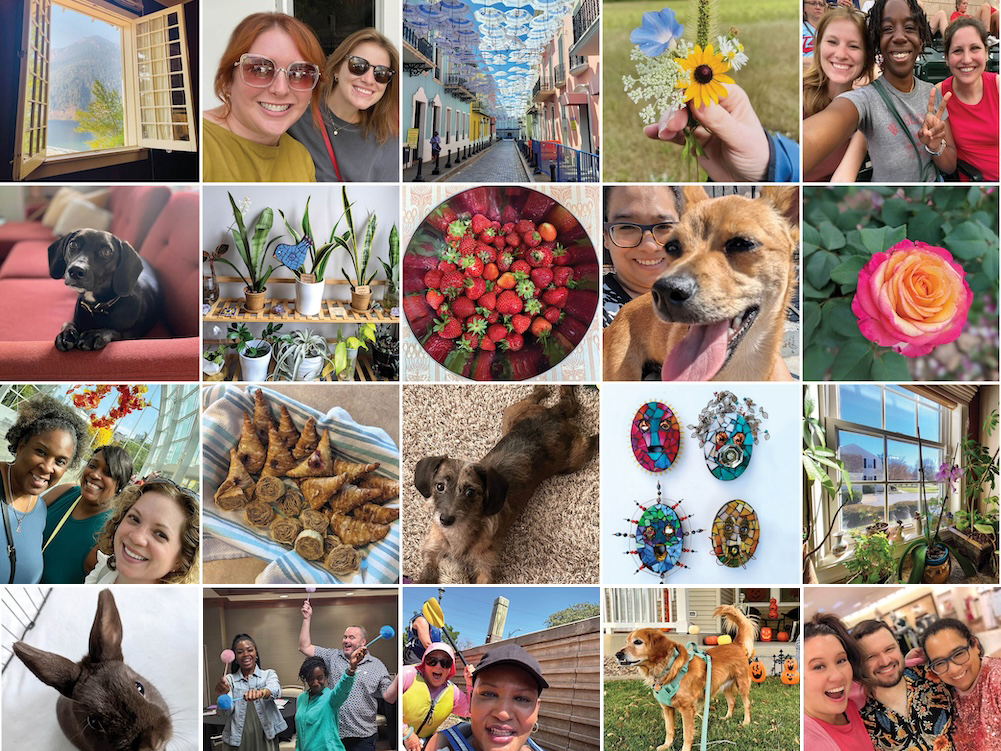
We also created virtual spaces to play and connect with one another. This has included weekly staff hangouts, which became a time for fun, non-work conversations, biweekly activities (Drawasaurus and qi gong movement are two of our favorites), and pop-up events like Earth Day bingo and a day at a virtual summer camp—complete with s’mores and team games, of course. We also embraced Slack as a virtual break room, with channels dedicated to showing appreciation for colleagues and their accomplishments, random sharing, gardening, and recipes. Each of these initiatives have made space for us to get to know one another as full people. In 2022, a lull in the pandemic gave us an opportunity to build on the foundation we built in a virtual environment. We participated in our first annual staff retreat, coming together in Chicago for a week dedicated to togetherness, exploration, and fun as a team. This past summer, we retreated in Minneapolis, applying lessons learned from our first retreat to create more spaces for team learning and fun time, one-to-one conversation, and board and staff interaction.
How is this all relevant to rest and wellness? We’ve increased our organizational capacity to both work and to provide support for one another. And well rested individuals are able to bring their best selves and their best ideas and feel safe and successful in their work. It’s about opportunity for others. A professional staff member who is cross-trained can take on an interim role during another’s break while at the same time gaining practical experience for a future role. And in living by the belief that if you put people first, the work supporting our mission will get done, we’ve created the spaces for staff to try, succeed, or fail with love, not judgment. It’s in those vulnerable moments you learn humility, learn to ask for help, or learn to offer it when you see someone drowning. That’s a different workplace framing from what most of us are used to.
What are the most challenging obstacles to successfully operationalizing rest and wellness as a facet of a people-forward organization? Time, financial support, and trust. Our collective wellness is a work tool that brings us refreshed perspectives, energy, and personal satisfaction. In focusing on radical rest, PEAK has seen a radical organizational evolution in just a few years—and we hope that in sharing the impact of our rejuvenation practices, others in our community will similarly explore the possibilities. Our first lesson learned is that radical rest is not so radical at all—it’s what we all deserve.
Image: A selection of the many team shares across our Slack channels—from images of our furbabies to arts and crafts, travel adventures, retreat selfies, and more!
Meet the Author

Dolores Estrada
Chief Operating Officer, PEAK Grantmaking
Principles for Peak Grantmaking
Read more insights related to this Principle:
Learn, Share, Evolve
Related Topics
Organizational LearningSelf-Care & Wellness
Related Articles
To Ensure Nonprofit Well-Being, Invest in Wages, Workload, and Working Conditions
READ
Harnessing Power and Pleasure to Navigate Philanthropy as Black Women
READ
Wellness Practices From the PEAK Team
READ