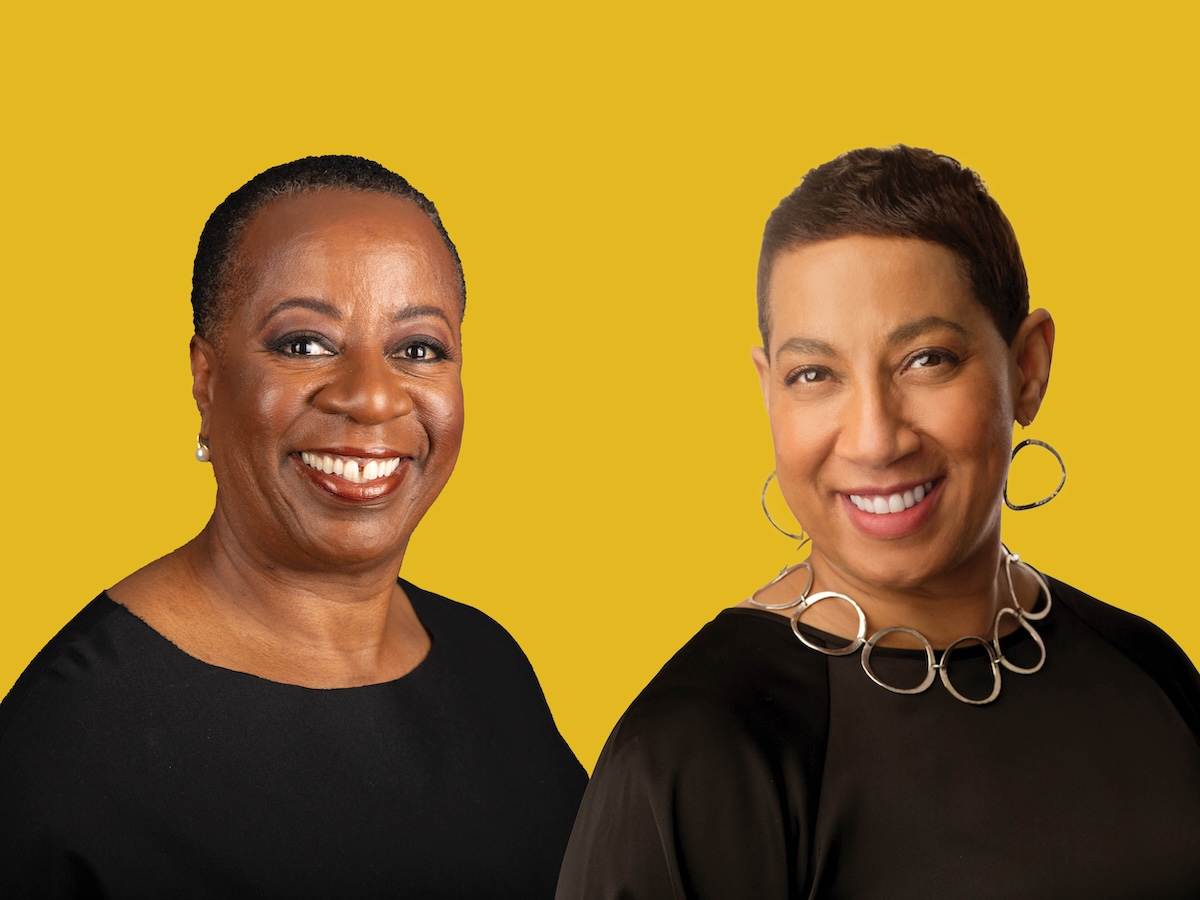
Walter and Elise Haas Fund Executive Director Jamie Allison’s path to leadership began in her teens. Knowing that she wanted to study political science, a government career seemed like the obvious path to take, and she committed to the idea when, during a family trip to Washington, DC, her parents bought her a souvenir T-shirt that said “Future President.”
“I don’t know that I was focused on becoming president of the United States,” Allison recently told PEAK President and CEO Satonya Fair. “I was committed to community, I was committed to service, I was committed to the public good. And it turned out I got to be a future president of a foundation.”
In these highlights from their conversation, Allison and Fair share their thoughts on the importance of finding communities of peers and mentors and sharing the power you have to both build your career and help others along their path.
Fair: You are president of a storied family foundation. What has surprised you along the way to becoming executive director of the Walter & Elise Haas Fund?
Allison: Though the decisions might seem disconnected, every decision that I have made has helped me to make a solid path. And along the way, I made connections to the Walter & Elise Haas Fund without even knowing it.
While I was in graduate school at The Richard and Rhoda Goldman School of Public Policy at UC Berkeley, I interned at the Levi Strauss Foundation, which is the source of wealth for the Walter & Elise Haas Fund. In addition, every graduate student had to do a capstone project, and my client for that project was Richard Goldman. Fast-forward: I go on to work at the S.H. Cowell Foundation for 12 years, as a program officer and, ultimately, as vice president of programs, before joining the Walter & Elise Haas Fund as executive director. And in my second year there, John Goldman, Richard Goldman’s son, was my board chair. I could not have predicted that my life and career would be intertwined so closely with the Haas-Goldman family.
Every decision that we make leads somewhere. There’s a cumulative impact of those decisions. I feel fortunate that I’m in a place in my life where I can see those connections and the positive trajectory.
Fair: In my circles—my friends, my family, my sister circle —we say, “The universe knows.” Everything that we do matters, how we land in different places and spaces. That has me thinking about all the people who have come into your path—mentors and people you have admired. Have there been places along your career path where you weren’t moving in the direction you thought you should? How did you reset and navigate those barriers?
Allison: My brain does not compute setback. My brain does not compute failure. My brain does not compute regret. So, I cannot say that I have ever had a career setback. What I can say is that there have been times when I had to say to myself, “Jamie, what do you need to do to be the person you were raised to be, the person you were meant to be, the person that you want to be? How do you ensure you are doing everything required to fully actualize that person?” In my life and career, I have a goal to be fully engaged in the community and ensure that the generations that come next are better off than the current generation. How do I figure out how to do that every day? Figuring out how to live and embody that charge is up to me.
When I was a young program officer, there weren’t many other young program officers or young program officers of color. There was one other person from my graduate program, Angie Chen, who also went to work in philanthropy. As a result, we found each other.
We made it our business to find other young program officers—some of color, some not—so we could support each other. Angie and I invested in our relationship, and we have been collaborating and learning from each other for years. Today, I’m an executive director of a foundation, Angie is an executive director of a foundation, and we have a standing monthly call. We are going to be on each other’s team for life.
And after speaking at PEAK2024, I got a message from another attendee, Corey Murphy, who asked me for career advice. We had a couple of conversations, he checks in to give me progress updates on what he’s doing, and how whatever advice I may have given him landed. But I am not mentoring him. We are mentoring each other. I learn from every conversation we have.
He recently asked me if I would speak with PEAK’s Black Caucus so that others could benefit from my experiences. Of course I would! Do I have time for it? I sure don’t. But am I going to do it? Absolutely. This is why I’m in the work. Creating a circle of care and investing in myself are the things that helped me along my path. I see Corey working to do that too. He’s someone who is serious about his career, who sees an opportunity to build his network, and then make this circle of care wider. That’s huge. I respect and admire that so much. So it’s my responsibility and my honor to support that.
Fair: It’s a mindset of not keeping knowledge to oneself. So much of what we preach here is about advocating well for oneself and for others. Getting ahead alone is not the goal. PEAK is truly a network. Regardless of where you came from, where you are, or what your title is, it’s a community of peers, and members have been bonding together for years to help each other be better and to make philanthropy better. This network has kept me alive. For example, the Grants Management Directors’ Circle came together almost 12 years ago because a group of us were trying to figure out how to get our teams seen, get ourselves seen, and to do better in our roles. When you build a network, you can watch each other’s leadership qualities blossom and continue to be each other’s best cheerleaders. That’s why we have to do this work with fidelity.
Allison: And even if a connection doesn’t seem relevant at the time—that person will probably show up again and they will remember how you treated them. And that memory can either be a good news story, or it can be a painful or traumatic story about the person who disregarded them, the person who disrespected them, the person who underestimated them, the person who wouldn’t give them the time of day. We are all human souls on a journey trying to do the best we can, and how I treat people matters in the short-term and in the long-term.
Fair: People won’t remember what you did, but they’ll remember how you made them feel. When programs people leave the room, how will the nonprofits feel on the other side of a discussion or grant transaction? It’s such a simple way to advance equity: Think about how people feel on the other side of the conversation.
To that point, you are known in our circles as a CEO who understands PEAK’s people. We know that you see us, and you see the superpowers that we bring to any organization. When you started to think about the shifts that you wanted to make at the Walter & Elise Haas Fund, how did you center the strengths of operations folks and people who come from grants management?
Allison: We are approaching change by busting silos between our programmatic areas. Why do we have an education program that’s separate from economic security, that’s separate from safety net? Aren’t they all interrelated?
Also, having a program team that met separately from the grants management team and from admin was counterproductive. Some of the things the program team is dreaming and scheming about directly impacts grants management and admin, and those teams have more information about how to do the things that the program team wants. Now we’re all in the same meeting. When folks say, “I think I need this,” then everyone gets to weigh in and say, “I think I can figure out a way for us to do it.” We’re constantly talking about one Walter & Elise Haas Fund. We’re smarter together. We hold each other accountable. We help each other learn and grow.
Fair: We have to be more innovative if we want to solve complex problems.
Allison: And if we really want a just, inclusive, multiracial society, our organizations have to mirror that. We have to practice that inside of our organizations every day. I have a personal rule that I don’t ask anyone to do anything I’m not willing to do. So, if I want our elected leaders or leaders in other organizations to create policies and systems and behave in ways that include and uplift all of us, then I have to do those same things inside my spheres of influence.
Pete Haas was chair of the board and the search committee when the foundation was filling the role I now have. The day that he offered me the job, he invited me to lunch and said, “Every single person that we talked to, from the formal search and from the community, had positive things to say about you.”
It was a reminder that, in addition to the official search process, people check in with their network to ask if they know or have heard of a person.
Fair: It’s about using power for good—making sure that trust is centered, and trying to disrupt some of these power gaps.
Allison: What’s important about power is how we use it, and we all have some kind of power: collaborative power, positional power, obstructive power. As executive director, I have to use my positional power to amplify the voices of people who usually get ignored and to open doors for people.
Fair: So, what advice would you give to other philanthropic professionals for being the best champions at work and in their community?
Allison: Figure out what kind of power you have personally, within your institution, and in your networks. Then, figure out how to use that to advance your goals— and never shy away from that.
Fair: You’ve just given us a primer for reimagining power for good and understanding that how we show up really matters. It’s not about you being the CEO and using that power for good. It’s about you being you and using that power in the right ways, at the right times.
Meet the Author

Jamie Allison
Executive Director, Walter and Elise Haas Fund

Satonya Fair
President and CEO, PEAK Grantmaking
Principles for Peak Grantmaking
Read more insights related to this Principle:
Drive Equity, Steward Responsively
Related Topics
Career DevelopmentCEO:CEO
Related Articles
Forging Empathy With Determination to Create a New Sector
READ
Leading the Charge for Disability Justice in Philanthropy
READ
The Community-Centered Evolution of United Way Worldwide
READ