Everyone I talk to seems to be going through it. While many of us have developed strong resiliency muscles in recent years, many people are straining under the weight of navigating ongoing, overlapping, high-tension changes. Of these muscles, we may have a strong IQ—intelligence quotient—and EQ—emotional intelligence quotient—but our TQ—transition intelligence quotient, a term coined by my colleagues at the Modern Elder Academy—is often underdeveloped.
Though they may be conflated, TQ is not the same as change management. TQ is about how we respond to changes, not how we manage them. Let’s clarify the difference: Change is external—something that happens to us, like a kid leaving for college or a new software implementation. Transition intelligence is how we respond to changes—how we emotionally and mentally move through a given change.
As odd as it sounds, transitions begin with an end—someone leaves the organization, a longstanding law is reversed, or a child moves out. After these endings, we enter the messy middle—the disorienting space between what was and what will be. As chaotic as it might feel, if we stay in it long enough, we uncover valuable lessons that guide us toward the new beginning. Endings. Messy middle. New beginnings. Rinse and repeat.
When we skip or race through any of these phases, however, we miss crucial learning opportunities. And if we don’t learn them this time, rest assured they’ll come around again. And again. But there are ways to resiliently meet these moments in our professional and personal lives.
Focus on the current state
Understanding and accepting where you are individually and organizationally is key to navigating transitions. This requires the practice of noticing—intentionally observing without judgment. In personal transitions, this means paying attention to subtle emotional shifts, while in organizations, it involves stepping back to assess team dynamics and shifting priorities. By pausing to notice, we can better understand the current state before jumping into action. This helps build resilience and ensures actions are grounded in reality. Every day offers us a chance to reflect and observe, laying the foundation for healthier transitions in both personal and professional settings.
Cultivate curiosity
In both personal and professional transitions, curiosity is a powerful antidote to fear, uncertainty, and doubt. When we approach an ending, the messy middle, or a new beginning with curiosity, we open ourselves to new possibilities, insights, and strategies that we may have otherwise overlooked. A key part of this is the practice of intentional listening—both to ourselves and to others—to identify areas of ambiguity or misunderstanding. Intentional listening allows you to ask thoughtful questions that aim to create a deeper understanding of other perspectives, concerns, and ideas. This not only fosters empathy but also allows for more informed decision-making. Curiosity, coupled with intentional listening, helps us slow down and manage the complexities of change with greater awareness, enabling both individuals and teams to become more adaptable in the process.
Proceed with compassion
Compassion is crucial during transitions, both for yourself and for others. Individually, it means being patient with your emotional process and allowing yourself the space to grieve endings, sit in the stew of uncertainty, and go with courage towards the new horizon. Organizationally, it means creating a supportive environment where team members feel safe expressing their struggles and concerns about the changes ahead.
Compassion fosters psychological safety, allowing people to be vulnerable without fear of judgment. This emotional support is what strengthens team dynamics, creating trust and cohesion. When we give ourselves and our teams the grace to move through transitions at a natural pace, we create stronger, more resilient organizations capable of thriving in this volatile, uncertain, complex, and ambiguous world we call home.
Return to purpose
Regardless of where you might be in a transition, if you have a larger purpose, it is going to be far easier to withstand the discomfort that change invites. Many organizations have vision or mission statements that define their “why,” which helps individuals find direction, motivation, and meaning in the changes they’re experiencing. Purpose is an anchor for both individuals and teams, keeping them grounded when the future is unclear. For leaders, communicating a shared vision helps employees understand the bigger picture and provides an opportunity for them to connect emotionally with the organization’s goals. On a personal level, that shared purpose allows individuals to use a transition as an opportunity to reflect on their own deepest values and how they align with those of the organization. By focusing on purpose, we are able to navigate change more effectively as our full selves.
Gracefully navigating change
The same skills that help individuals navigate personal transitions are the ones that build healthier, more resilient organizations. From my perspective, meetings are the most visible manifestation—and leverage point—for shifting organizational culture. How we gather and the rituals we follow reinforce the patterns that either propel us forward or hold us back.
What if every meeting had a clear intention—whether it’s to decide, ideate, debate, or simply update—to bring much-needed clarity and focus to the work? Imagine starting with a moment to check in with one another before diving into content. Picture a meeting agenda designed around questions that spark curiosity and engagement from all participants rather than just tasks. What if we celebrated those who challenge the status quo and encourage the team to think differently? Could we shift from a purely task-oriented workflow to one that’s more relational and purpose-driven?
The pace of change isn’t slowing down anytime soon. But by nurturing our EQ and TQ—by honing our awareness, curiosity, compassion, and purpose—we can not only navigate transitions more smoothly but also emerge stronger and more whole, both as individuals and as organizations. Who in your organization embodies these principles? Who can support you in practicing them in your life? The more we work on these skills, the more equipped we’ll be to thrive in a world of constant change.
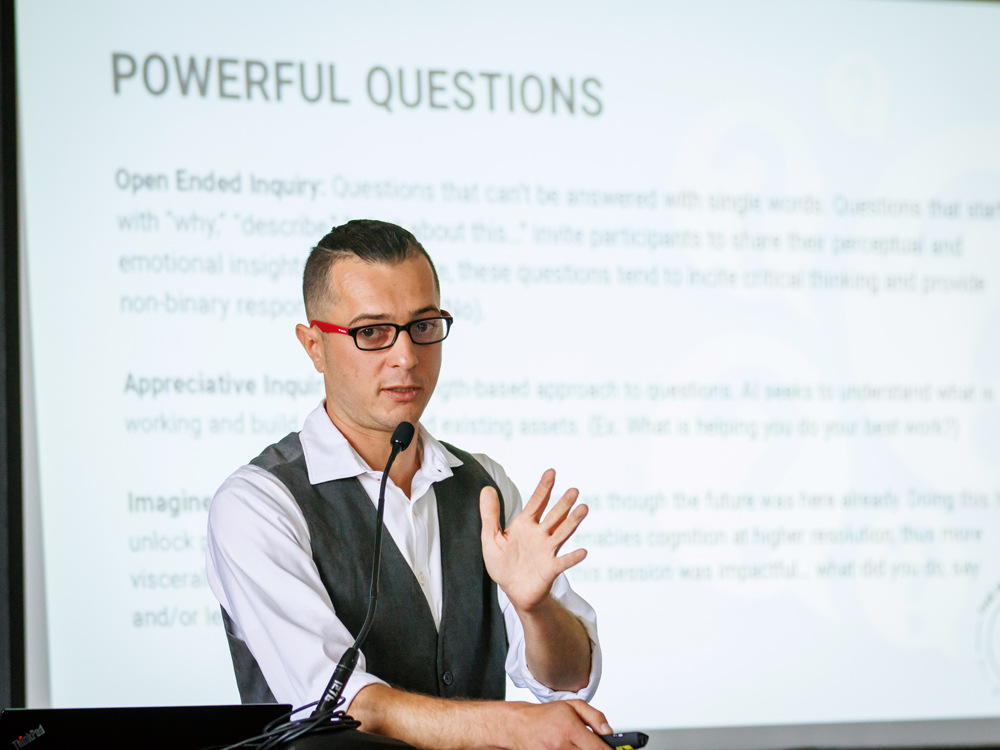
Image: At PEAK2023 in Baltimore, Daniel Weinzveg speaks on collaborating in ways that narrow power gaps and generate group genius. Photo by Greg Smith.
Meet the Author

Daniel Weinzveg
Founder, The Meeting Guru
Principles for Peak Grantmaking
Read more insights related to this Principle:
Steward Responsively
Related Topics
Organizational LearningRelated Articles
Maintaining the Learning Momentum After a PEAK Convening
READ
How a PEAK–BSU Partnership Helped Me See a Career in Philanthropy
READ
Six Insights on Organizational Learning
READ