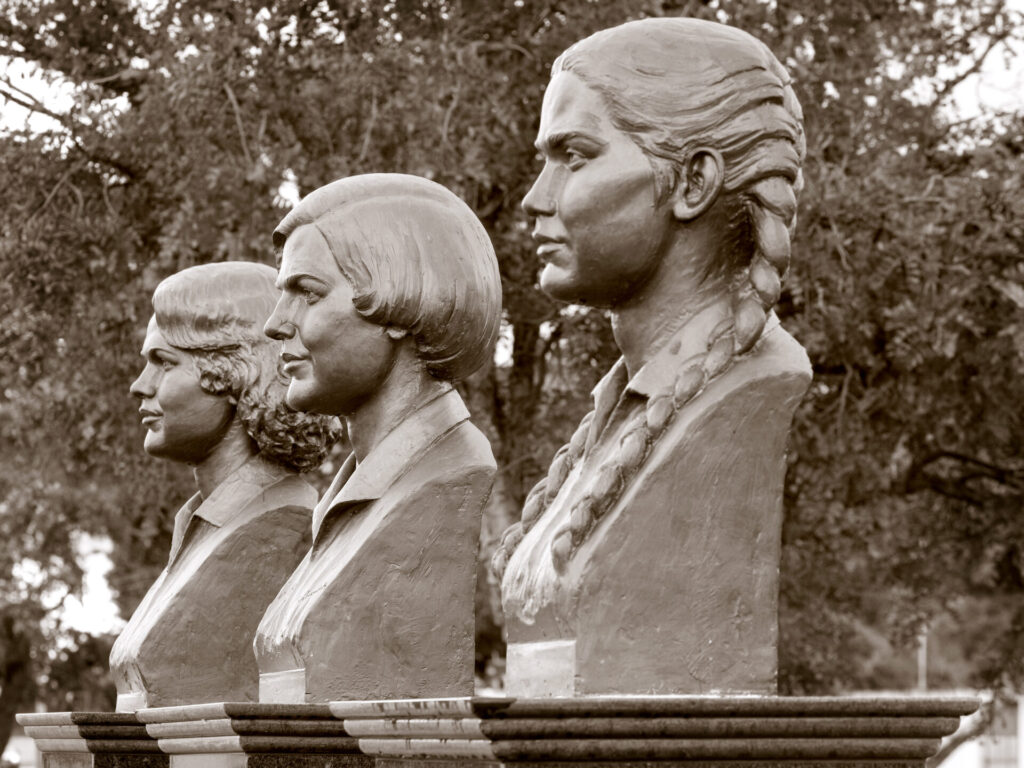
Women’s History Month invites us to reflect on and honor the women who dare, who inspire, and who have been trailblazers in the social sector. We were pleased to receive the following essay from PEAK board member Janet Disla on María Mirabal whose political activism helped to overthrow a dictatorship and has made her and her sisters international icons of social justice and feminism.
Learning about María Mirabal and her sisters Patria and Minerva—more affectionately known as Las Mariposas (The Butterflies)—was one of my first introductions into the history of my beautiful homeland of Quisqueya in the Dominican Republic. In a culture where machismo behavior dominates, her heroism and courageousness inspired millions of women, including myself and many women in my family, to follow in her footsteps of advocacy, activism and community organizing. María’s story also taught me the concept of connection and allyship and that there is a space for me within the Dominican community even while living abroad. She taught me at an early age that just because society dictates that you should be in a certain place because of your gender, that does not mean you actually belong there.
María Argentina Minerva Mirabal Reyes, born March 12, 1927, was the first woman to graduate from law school in the Dominican Republic, and she is best known for her role as a pioneer in the resistance movement against Rafael Trujillo, who ruled as dictator of the Dominican Republic from August 1930 until May 1961. Along with her husband, María formed the 14th of June Movement, named for the failed 1959 insurrection against Trujillo. In Trujillo’s countrywide sweep of mass arrests of resistance figures, María , her sisters, and their husbands were taken into custody. To show leniency to the women, Trujillo later freed the women, but their husbands did not receive this same treatment. On November 25, 1960, on their way home from visiting their husbands in jail, the Mirabal sisters were beaten and strangled by Trujillo’s henchmen.
Though María and her two sisters’ lives were cut short at an early age, they instantly became martyrs for the revolutionary cause, helping solidify resistance to Trujillo both at home and abroad. Because of their national popularity, the assassinations of the Mirabal sisters were catalysts for the downfall of Trujillo’s regime, which ended with his assassination in 1961. The sisters’ deaths were considered among the most heinous acts committed during the Trujillo dictatorship. The legacy of Las Mariposas has been commemorated due to the large amount of gender-based violence within Latin America. In 1981, the Latin American and Caribbean Feminist Encuentro—the first in a series of conferences that strove to change policies toward women throughout the region—declared November 25 as the Day for Non-Violence Against Women. In 1995, the United Nations adopted the day as the International Day for the Elimination of Violence against Women.
María’s legacy continues to give me the motivation and strength to speak up against inequities happening within the communities I am a part of. María’s story has taught me that the power of narratives, organizing and educating people can build collective power. In a world that constantly discounts women’s contributions to history and bringing about positive change, María’s story gives me hope that my voice and opinion matters, and I can lead from wherever I am.
Image: Statues honoring the Mirabal sisters (from left) Minerva, Patria, and Maria
Photo by Rômulo Serpa/Agência CNJ
Meet the Author

Janet Disla
Senior Grants Manager, The Nathan Cummings Foundation, and PEAK Grantmaking Board Member
Principles for Peak Grantmaking
Read more insights related to this Principle:
Drive Equity
Related Topics
Diversity, Equity & InclusionRelated Articles
Intentional Relationships Require Courage: Five Undoings for Philanthropy’s New Year
READ
Advancing Equity Through HBCU Leadership
READ
Leading With Love and Finding Joy in 2025
READ